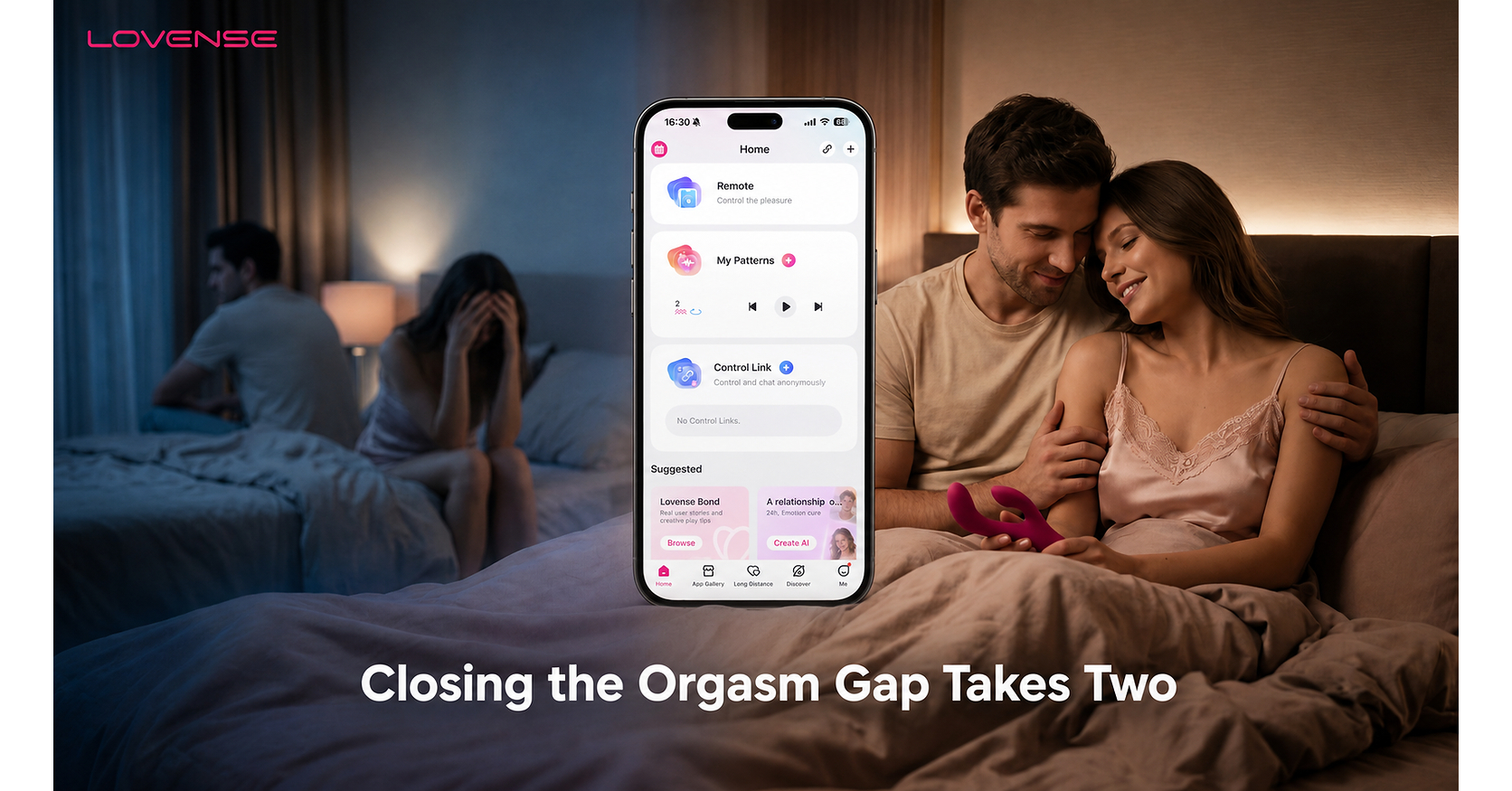
On June 22, 2026, intimacy-technology company Lovense launched a public campaign and initiative under the banner "Closing the Orgasm Gap Takes Two," reframing the persistent disparity in heterosexual partnered pleasure as a shared responsibility rather than a women's-anatomy problem. The campaign marshals a stack of peer-reviewed research to make its case and pairs the messaging with the company's connected-device lineup positioned as tools to help couples close the gap.
Why It Matters
The orgasm gap is one of the most durable consumer-insight narratives in sexual wellness, and tying a product line to peer-reviewed research is now table stakes for brands seeking mainstream credibility and retail shelf space. Campaigns like this expand the category's addressable framing from "novelty" to "relationship health," which supports premium pricing and partnered (not just solo) use cases. It also signals where marketing spend is flowing as the connected-device segment competes on education and trust rather than raw feature lists.Lovense anchors the effort in fresh academic data, citing a 2026 Rutgers University study published in The Journal of Sex Research finding that women who consistently fail to orgasm with a partner may psychologically "devalue" the importance of their own orgasm over time. It layers in well-established figures: roughly 95% of heterosexual men usually orgasm during sex versus about 65% of heterosexual women, while an oft-cited 2018 Archives of Sexual Behavior study of 52,588 Americans found 86% of lesbian women reach orgasm — same anatomy, very different outcome. The company also points to a 2025 Wolfer and Carmichael study describing a "pursuit gap," in which men actively pursue their own orgasm and feel supported doing so while women's pleasure is treated as optional.
The campaign's argument leans on The Journal of Sexual Medicine's identification of two primary pleasure pathways — clitoral (external) and G-spot (internal) — and the finding that combining both produces stronger, faster orgasms than either alone, while only 18% of women orgasm through penetration alone. Lovense uses this to position its connected vibrators and couples devices as practical interventions, but the messaging notably emphasizes behavioral and psychological change — encouraging both partners to make women's pleasure a shared priority — over a pure product pitch.
For the industry, the move is a textbook example of "pleasure-gap" marketing maturing into evidence-backed advocacy. Brands from Womanizer to Magic Wand have increasingly commissioned or cited research to legitimize sexual wellness as a health-and-wellbeing category; Lovense's campaign continues that destigmatization arc while subtly defending the relevance of teledildonics and couples tech at a moment when the company is also navigating security-reputation fallout from 2025 disclosures.
Sources
- Closing the Gap Takes Two: Lovense Launches Initiative in Response to Decades-Long Orgasm Gap (PR Newswire)
- Lovense Calls for "Closing the Gap Takes Two" Amid a Decades-Old Orgasm Gap (PR Newswire)
Update — 2026-06-26
Initial entry — story first created.