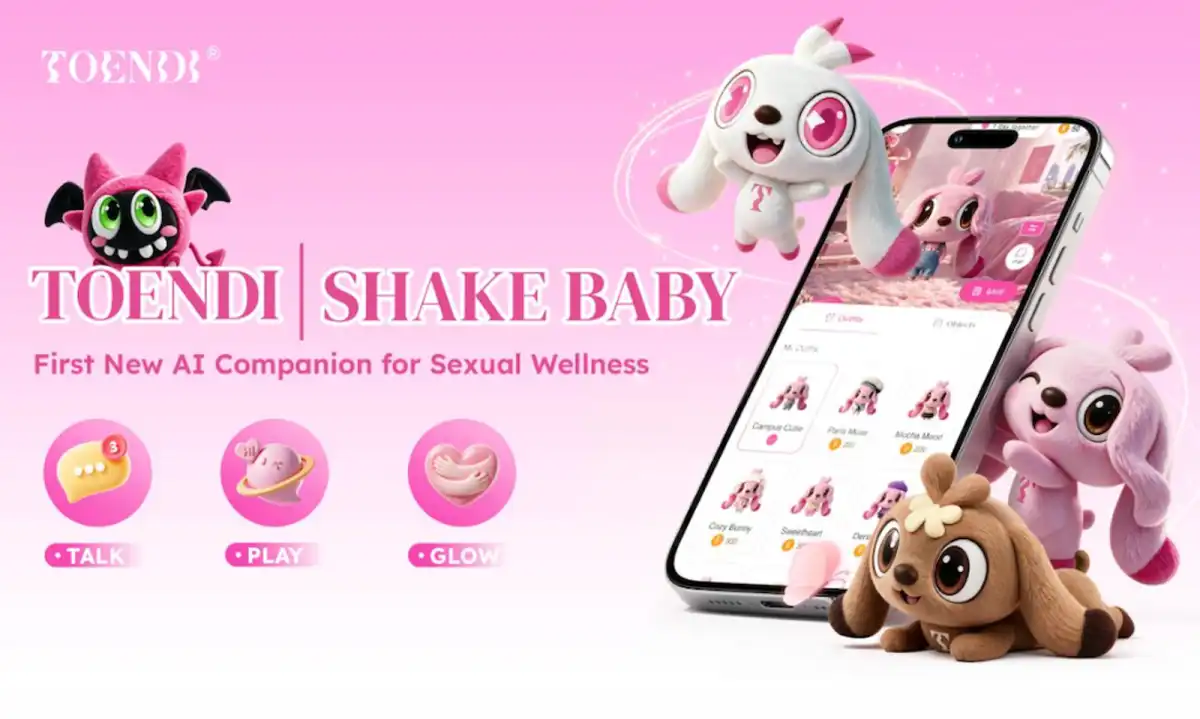
On September 23, 2026, pleasure brand Toendi launched ShakeBaby, which it describes as "the industry's first AI companion designed specifically around sexual wellness," available through the Toendi website. Users pick one of three characters — Nori, Lumi or Luna, each assigned a Myers-Briggs type and a personality (Nori an INFJ, gentle and healing; Lumi an ENFP, the friend who helps you make sense of things; Luna an INFP, more sensitive and emotional) — and talk to it about Toendi products or sexual wellness topics generally. The company's stated aim, per a development-team representative quoted by Erotic Trade Only: "We wanted each Baby to feel like a companion with their own personality, rather than simply another AI chatbot. Users can choose the one they connect with and build a relationship with them over time."
Why It Matters
This is the category's most explicit fusion yet of AI companionship and hardware commerce, and the direction of travel is the opposite of what most brands have tried. The obvious play — the one Blush ran with its EnLust AI-avatar strokers — is to sell physical products as merchandise for a digital persona. Toendi is running it backwards: the persona exists to sell and support the hardware, and the reward for enough engagement is a free device. Both directions converge on the same commercial insight, which is that an AI relationship is a retention mechanism a vibrator cannot be. A device is bought once; a companion is opened daily. Two risks sit in the design. The first is compliance: every meaningful AI-companion statute now in force keys on age assurance and on manipulative engagement patterns, and a coin-and-streak loop is a textbook example of the latter even with an adult-only audience. A brand operating this in California, the EU or the UK should assume the loop, not the chat, is what draws attention. The second is trust. A companion whose job is simultaneously to answer sexual-health questions and to move Toendi SKUs has a conflict baked into its system prompt — the one place in this sector where users are most vulnerable to bad information is also the place where a branded assistant has the least incentive to say "buy nothing" or "see a clinician." Watch whether any brand in this category publishes what its companion will and won't advise on. That disclosure, not the personality types, is what would make this trustworthy.What separates this from a support chatbot is the retention mechanics bolted on top, and they are worth reading closely. Users complete daily tasks to earn coins, which buy outfits and other customisation for their chosen Baby. Continued interaction accumulates "companionship days," which unlock further rewards. Reaching the highest companionship level earns a free Toendi product. That is a gacha-adjacent loyalty loop — daily login, soft currency, cosmetic sink, tiered unlocks — grafted onto a sexual-wellness brand's owned channel. The representative was unusually candid about the design intent: "The daily tasks, outfits and companionship system give users reasons to come back, while the AI experience makes it easier to learn, ask questions and explore at their own pace."
Toendi itself is a Shenzhen-lineage women's-pleasure brand founded in 2020, best known for rabbit-style dual-stimulation devices and, more recently, the Aurora seat-style vibrator series Afterglow covered in June 2026. It markets on phthalate-free silicone, multi-mode thrusting and licking mechanisms, and anatomy-specific design, and runs a user community called ShakeHub. ShakeBaby is positioned as education-plus-support-plus-companionship in one surface — a customer-acquisition and retention asset dressed as a wellness feature.
The regulatory backdrop makes the framing choice conspicuous. AI companions are, as of this month, one of the most actively legislated product categories in consumer technology: California's SB 1119 ("Adam's Law") and AB 1709 were signed on September 10, Oregon and Washington passed the first companion-chatbot safety statutes earlier this year, a leaked European Commission "Kids Act" draft would bar under-15s from AI chatbots entirely, and the UK's Advertising Standards Authority banned five AI-companion and nudification ads on September 16. Nearly all of that regulation turns on minor safety, disclosure that the user is talking to a machine, and engagement mechanics designed to extend sessions. ShakeBaby's daily-task-and-reward architecture is precisely the pattern legislators have been naming as engagement-maximising design, attached to a product category that is adults-only by definition.
Sources
- Toendi Shakes Up Its Product Support — Erotic Trade Only
- Toendi Launches ShakeBaby: An AI Companion for Sexual Wellness — Adult FYI
- Toendi Intros AI-Powered Sexual Health Companion 'ShakeBaby' — AVN
Update — 2026-09-28
Initial entry — story first created.