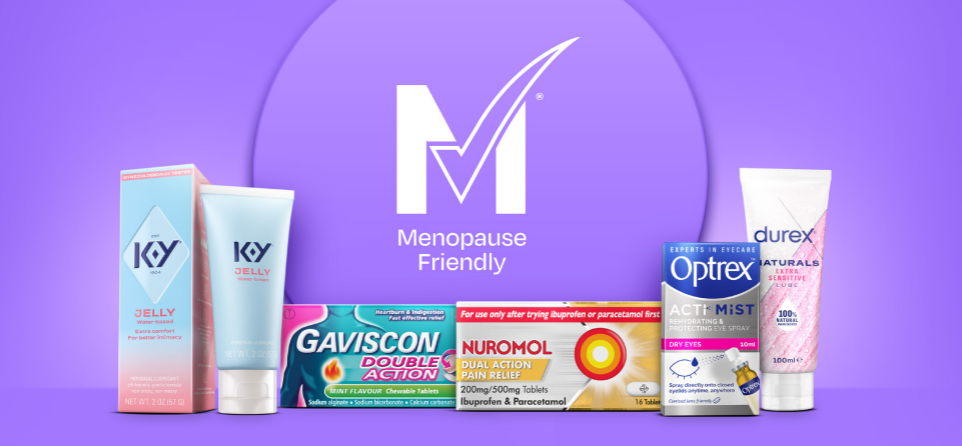
On August 27, 2026, Retail Times reported that Reckitt has joined the GenM Collective, with 21 products across five of its brands — Gaviscon, Optrex, Nurofen, Durex and K-Y — earning MTick certification. The MTick is a UK symbol and certification scheme signaling that a product may support one or more of the 48 recognized signs of menopause, and it appears on pack and on shelf so shoppers can identify menopause-relevant products without decoding ingredient lists.
Why It Matters
Retail placement is destiny in this category, and menopause is quietly becoming the most valuable shelf real estate in personal care. The reason is arithmetic: menopause lasts years, affects every woman, and — unlike the contraception market — the customer does not age out of it. A lubricant sold as a sex product competes on impulse and taboo. The same lubricant sold as menopause symptom relief competes on need, gets repeat purchase, and travels into pharmacy sections where sexual wellness brands have struggled to earn facings. This is also a low-cost, high-leverage move for the incumbents. Reckitt did not launch a menopause line; it certified existing SKUs. That is the strategic tell — the fastest route into the menopause category is relabeling and re-merchandising products you already manufacture at scale, and it puts pressure on the specialist menopause-intimacy startups (Joylux, Bonafide, and the wave of vaginal-moisturizer challengers) whose primary advantage was category framing rather than formulation. Two things to watch. First, whether MTick certification travels beyond the UK — GenM's 1-billion-woman global framing implies ambition, but the scheme's authority is currently British retail. Second, whether the certification bar stays meaningful as the collective scales past 150 brands. A trust mark's entire value is its scarcity; the moment everything on the shelf has a tick, nothing does.The inclusion of Durex and K-Y is the part that matters for this industry. Vaginal dryness and painful sex are among the most common and least discussed menopause symptoms, and lubricant is the first-line, non-prescription intervention — yet lubricant has historically been merchandised in the contraception or "sexual wellness" aisle, adjacent to condoms, framed entirely around younger consumers and pregnancy prevention. Certifying K-Y and Durex products under a menopause symbol moves the same SKUs into a completely different shopper journey: a woman looking for menopause support rather than a woman looking for sex products.
GenM frames the addressable market as 15.5 million perimenopausal and menopausal women in the UK and roughly a billion globally. The collective now spans more than 150 brands and retailers, per Retail Times, with the Reckitt additions covering digestive health, eye care, pain relief and intimate wellness.
"We're seeing more of the world's biggest brands recognising that menopause shouldn't sit on the sidelines of healthcare," GenM CEO and co-founder Heather Jackson said. "Every new brand that joins the GenM Collective helps make menopause support more trusted, visible, and accessible for women to navigate." She added that bringing household names under the MTick "is helping to normalise menopause with household brands that women know and trust." Nikki Hayward, Reckitt's Northern Europe category director for selfcare, represented the company on the announcement.
Sources
- Reckitt joins GenM as five household brands gain MTick menopause-friendly certification — Retail Times
- Home of the MTick — GenM
Update — 2026-08-28
{Initial entry — story first created.}
Update — 2026-10-10
The MTick gets a shop window, and Lovehoney has a shelf in it. From October 1 to 11, 2026, GenM is running what it calls the world's first menopause-friendly concept store, a pop-up on London's Kensington High Street created with raye the store. Every product carries the MTick certification. GenM says more than 4,000 products have earned the mark, and the store sells a selection across skincare, haircare, nutrition, femtech, food and drink, bedding and clothing. The space is designed for menopausal shoppers, with the temperature held at 21°C, soft lighting and educational signage on GenM's "48 signs" of menopause. Lead campaign partners are L'Oréal, E45, Pharmacy2U, Sainsbury's and Tesco. Lovehoney is a named campaign partner, putting sexual wellness alongside mainstream beauty and grocery on the same certified shelf. GenM cites its own research: about 15.5 million UK women are peri- or post-menopausal, spending £2.4B a year on health and beauty, and 96% want a one-stop menopause destination. Ten per cent of sales go to Beauty Banks.
Why it matters: When Reckitt certified Durex and K-Y, menopause-friendly sexual wellness became a supermarket label. A physical store that puts Lovehoney next to L'Oréal and Tesco tests whether it can become a retail category. Watch for sell-through data and whether any grocer makes the format permanent.