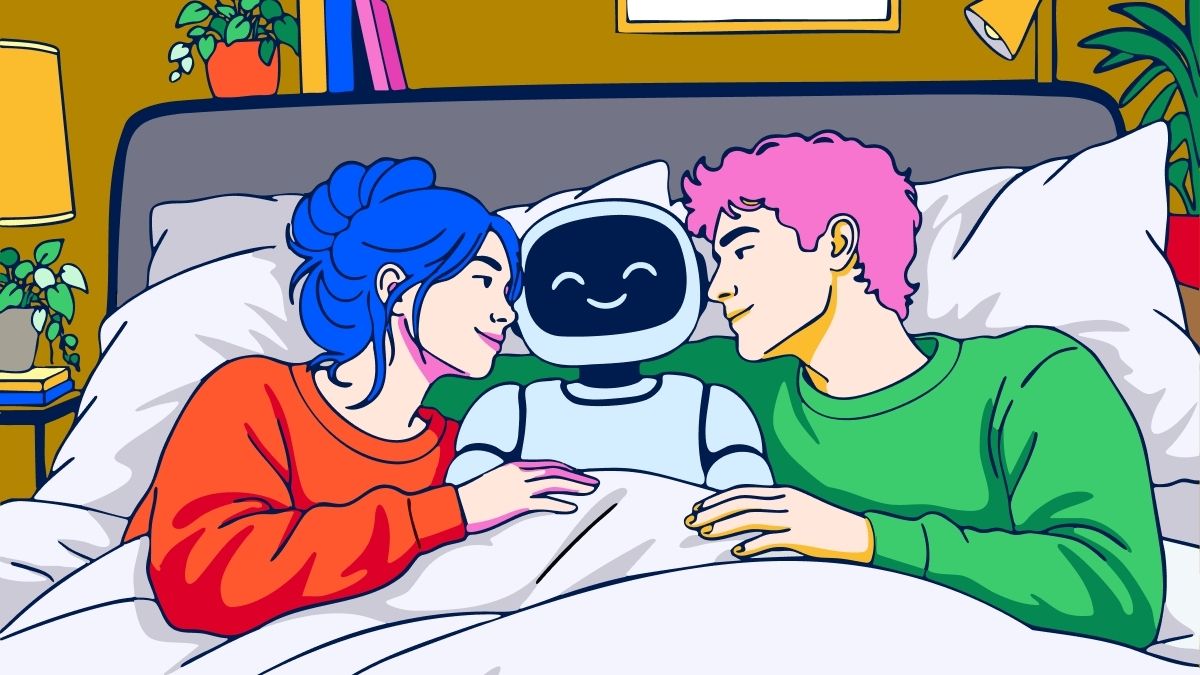
On October 27, 2026, security company Malwarebytes published Artificial Intimacy: Love and lies in the age of AI. It is based on a March 2026 survey of 1,500 people in the US, UK, Germany, Austria and Switzerland, conducted by an independent research consultant and distributed via Forsta. The headline finding: 37% say a romantic relationship with an AI chatbot while in a committed relationship isn't cheating. That rises to 46% of men vs. 30% of women, 43% of Gen Z, 45% of Millennials and 48% of regular AI users. About one in six have used a chatbot for companionship or emotional support, nearly one in four among regular AI users. 65% worry their private AI conversations could be exposed.
Why It Matters
These are three different measurements: a vendor survey, a small academic sample and a Kinsey poll. They agree on one thing: AI intimacy is now a **minority but mainstream behavior that skews male and young**. For companion-app and adult-AI businesses, that is demand validation. It is also the profile regulators are now writing rules around, from [New York's chatbot law](/stories/ny-chatbot-minors-safety-law) to Australia's "emotional intimacy" amendment ([updated today](/stories/australia-esafety-duty-of-care-escalation)). Commercially, the deepfake figures matter more than the cheating debate. If one in ten adults across five wealthy markets say they have been targeted with non-consensual AI nudes, and nearly a third don't clearly object to making them, the adult industry's liability exposure for generative tools is not hypothetical. Consent verification, likeness rights and takedown pipelines (the TAKE IT DOWN Act's 48-hour clock in the US, [Denmark's likeness-copyright bill](/stories/denmark-deepfake-likeness-bill)) become core compliance costs for any platform that lets users generate images. Note the limits: Malwarebytes' figures are self-reported and the company sells security software, and the Italian study is a convenience sample of 378.The darker numbers are more important. One in ten respondents say AI has been used to generate nude or sexually explicit imagery of them without permission, and one in ten say someone has threatened to release AI-generated explicit imagery of them. 62% worry it could happen to them (69% of women, 57% of men). About one in six say generating explicit images of someone without permission "for personal use" is acceptable, and another 14% are neutral, so roughly 31% don't clearly oppose it. Gen Z (24%) and Millennials (23%) are most accepting, compared with 5% of Boomers+. "The photo, the profile, and even the explicit image someone threatens to post might all be fake. The heartbreak isn't," said Shahak Shalev, Malwarebytes' global head of scam and AI research.
The same week brought a peer-reviewed data point. A Sapienza University of Rome team (Alessandra Ragona, Antonio Chirumbolo, Lia Ruggeri, Mara Morelli, with Elena Cattelino of the University of Valle d'Aosta) published in Archives of Sexual Behavior what Italian press describe as one of the first psychological studies of AI sexting. Of 378 Italian adults aged 18–35 in an anonymous online survey, 8.7% (33 people) reported sexting with an AI, and 75.8% of them were men. The behavior was significantly associated with sexual sensation seeking and problematic online pornography use. Quotidiano Sanità notes the researchers caution that the 8.7% figure can't be generalized to all young Italians. Separately, the National Coalition for Sexual Health's weekly roundup highlights a Kinsey Institute figure, reported by VICE, that 26% of Gen Z adults have had romantic or sexual conversations with AI chatbots.
Sources
- Artificial Intimacy: Love and lies in the age of AI — Malwarebytes (Oct 27, 2026)
- More than 1 in 3 people say dating an AI chatbot while in a relationship isn't cheating, Malwarebytes research finds — PR Newswire (Oct 27, 2026)
- Sexting con l'IA. Lo ha provato il 9% dei giovani intervistati, tre su quattro sono uomini — Quotidiano Sanità (Oct 27, 2026)
- Sexting, chi sono gli italiani che flirtano con l'AI — Galileo (Oct 30, 2026)
- Sexual Health in the News, October 23 – October 29 — National Coalition for Sexual Health (Oct 29, 2026)
Update — 2026-11-01
Initial entry — story first created.