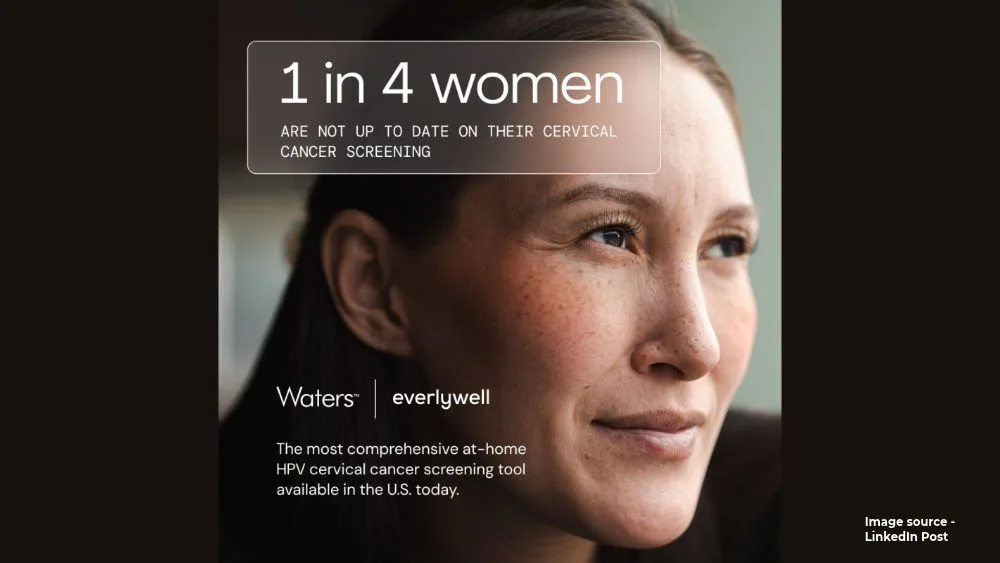
On September 16, 2026, Austin-based digital health company Everlywell announced a partnership with Waters Corporation to distribute the Onclarity HPV Self-Collection Kit, tested with the BD Onclarity HPV Assay, which the companies describe as the most comprehensive FDA-cleared at-home HPV cervical cancer screening tool currently available in the United States. The structure is what distinguishes it from the crowded at-home testing field: this is a health-plan-facing product, sold as a way for insurers to close a specific quality measure, not a direct-to-consumer kit.
Why It Matters
Self-collection has been the most-promised, least-delivered feature in women's health diagnostics for a decade, and it is now arriving through the payer channel rather than the consumer one. That distinction matters enormously for anyone building in this space. A DTC HPV kit competes on price, marketing and convenience against a free-at-point-of-care screening most insured women can already access; a plan-distributed kit tied to a HEDIS-family quality measure competes against the plan's own care-gap costs, which is a much easier sale with a much more durable reimbursement story. Afterglow has covered the parallel developments this launch now sits alongside — Color Health adding at-home HPV self-collection to its virtual cancer clinic, NHS England mailing HPV self-screening kits to four million women, and research showing nearly a third of American women in their twenties have never had a cervical screening. The picture across all of it is consistent: self-collection works, the barrier was never patient willingness, and the unlock is institutional distribution. Everlywell's announcement is the US commercial version of what the NHS did administratively. The timing detail worth flagging for anyone with a roadmap in intimate diagnostics: Everlywell is building to updated federal preventive-services guidance that takes effect in 2027, and to the NCQA MY2026 measure year now. Companies with self-collection products still positioned as consumer wellness purchases have roughly a year to decide whether they are selling to individuals or to plans — and the evidence from this deal is that the clinically validated, FDA-cleared, lab-processed configuration is the one that gets institutional distribution. The differentiator is no longer the swab. It is the referral pathway attached to an abnormal result.The measure is the point. Everlywell says it is among the first to market with an FDA-cleared at-home HPV testing solution built in direct response to the NCQA MY2026 update, targeting Cervical Cancer Screening–Electronic Clinical Data Systems (CCS-E) — one of the harder preventive screening measures for plans to improve, precisely because traditional screening requires an in-person visit. Members collect a sample at home and mail it to a CLIA-certified laboratory; results are delivered digitally through the Everlywell platform, with telehealth consultation available and in-person referral for members with abnormal results. The company also frames the launch against updated federal preventive-services guidance taking effect in 2027.
The clinical case is unambiguous. Everlywell cites American Cancer Society estimates of more than 13,000 new invasive cervical cancer cases diagnosed in the US this year, with one in four women not up to date on screening, and roughly half of women diagnosed with cervical cancer having never been screened or being overdue. Cervical cancers rarely occur in women who have been screened regularly before age 65. "Every woman deserves a clear and accessible path to understand her health and take the next right step," said Julia Cheek, Founder and CEO of Everlywell. "By bringing together outreach, convenient screening access, clinician-guided results, and connected care systems, we can help plans close care-gaps while preparing for the next generation of women's preventive care."
The pitch to payers is explicit about which members this reaches: those who are overdue, difficult to reach, or reluctant to complete in-office screening. That is the same population the entire at-home sexual and reproductive health category claims to serve, but this launch attaches the claim to an FDA-cleared assay, a CLIA lab, a referral pathway, and a NCQA measure a plan is already being scored on.
Sources
- Everlywell Announces a Partnership with Waters Corporation to Bring the Most Comprehensive FDA-Cleared At-Home HPV Cervical Cancer Screening Tool Available in the U.S. Today to Patients — Business Wire via Yahoo Finance
- Everlywell Expands At-Home HPV Screening Access — Health Tech Insiders
Update — 2026-09-19
{Initial entry — story first created.}
Update — 2026-10-21
Waters adds a second, bigger distributor: Quest Diagnostics. On October 20, 2026, Waters and Quest Diagnostics announced a collaboration to offer the FDA-cleared Onclarity Self-Collection Kit (run on the BD Onclarity HPV Assay) through Quest starting in 2027. Waters calls it the first of its deals to cover all channels at once: Quest's clinician network, its Gaps in Care program for health plans, consumer-initiated testing at questhealth.com, and drop-off at roughly 2,000 Quest patient service centers, with samples processed on automated BD COR systems. Quest says it serves one in three American adults and half of U.S. physicians and hospitals each year. Waters' Dr. Jeff Andrews cited more than 24 million un- and under-screened people in the U.S. and about 14,000 new cervical cancer cases a year. Waters also says the assay is the only FDA-approved HPV test that supports all ASCCP risk-based management guidelines through extended genotyping.
What changed: In September, Everlywell's deal put the kit into health-plan formularies. Quest now adds clinicians, retail drop-off and a direct-to-consumer storefront at national scale. That puts Waters' product squarely against Teal Health's wand, and the 2027 launch lines up with the expected federal preventive-services change for self-collection that Teal has bet its round on. It also partly answers the access gap in JAMA's never-screened data: a kit you can drop at a lab near your pharmacy addresses the "no appointment available" problem directly. Pricing and coverage terms weren't disclosed.