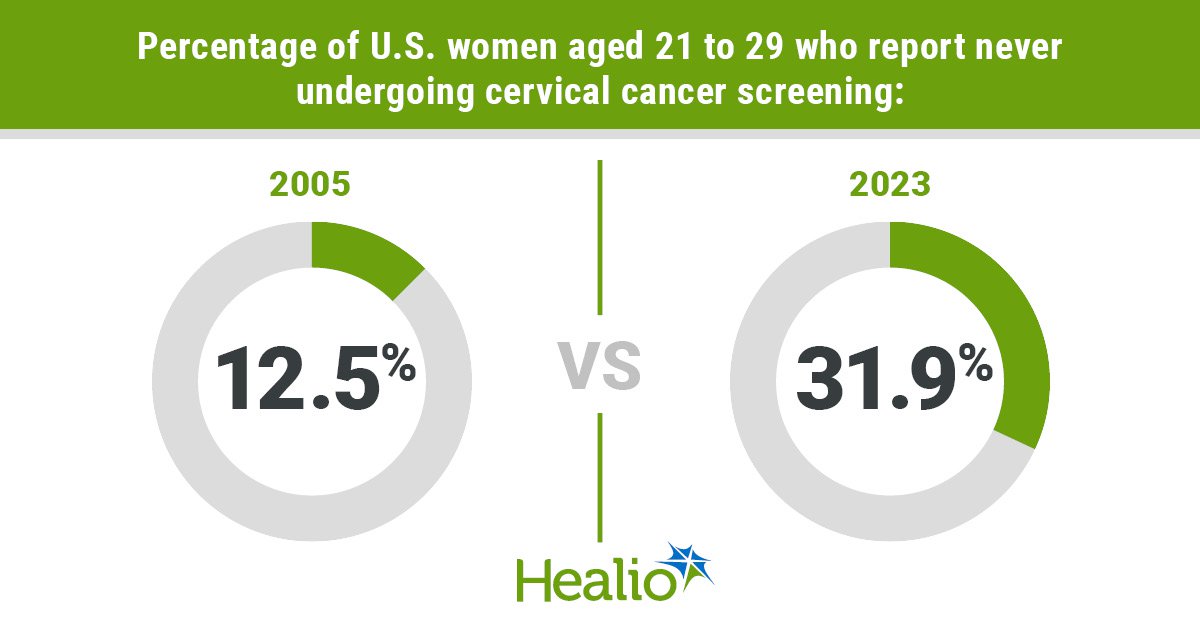
On August 27, 2026, researchers at MUSC Hollings Cancer Center published findings in JAMA Network Open showing that the share of U.S. women aged 21 to 29 who have never been screened for cervical cancer rose from 12.5% in 2005 to 31.9% in 2023 — roughly one in eight to nearly one in three inside two decades. The analysis, led by Kalyani "Kelly" Sonawane with Haluk Damgacioglu, Trisha L. Amboree and colleagues, drew on 23,502 women in that age band. Healio picked the study up on September 9 under the headline quote "truly shocking," and coverage has since rippled through CIDRAP, Inside Precision Medicine and Oncology Nurse Advisor.
Why It Matters
For the at-home diagnostics segment, this is the market thesis stated in a peer-reviewed journal. The entire self-collection wave — NHS England's mailed HPV kits to as many as 4 million non-attenders, Color Health's addition of the FDA-cleared Onclarity self-collection kit, Daye's Diagnostic Tampon, Papcup's electrochemical menstrual-blood assay — is predicated on the claim that the binding constraint is not test accuracy but the clinic visit itself. A never-screened rate that has more than doubled among women in their twenties is the strongest evidence yet that the constraint is real, and that it is worsening in the youngest, most digitally native cohort. It also reframes the commercial opportunity. A woman who is behind on screening is a reactivation problem; a woman who has never been screened is an acquisition problem, and those require completely different products, channels and messaging. Brands that have optimized for "you're overdue" reminders are addressing the shrinking half of the gap. The growth is in first-touch — which favors retail placement, direct-to-consumer kits, employer benefits and telehealth front doors over anything routed through an existing gynecological relationship the patient does not have. The one number worth stressing carefully: 31.9% is the never-screened share for ages 21–29 in 2023 specifically, not for U.S. women overall. It should not be generalized beyond that band.The number is counterintuitive because national screening statistics usually look fine. As CIDRAP noted, most national surveys report the "up-to-date" rate — how many women are current on screening — which flatters the picture by folding in the large population of women who were screened at some point. The never-screened rate isolates women who have never entered the screening pipeline at all, and that is the cohort that is growing. Standard U.S. guidance calls for a Pap test every three years from 21 to 29, and HPV/Pap co-testing every five years from 30 to 65.
The study does not settle causation, and the researchers are careful about that. Plausible contributors span the guideline changes that pushed first screening later and lengthened intervals, HPV vaccination creating a (mistaken) sense that screening is redundant, insurance churn and the erosion of routine gynecological care among younger adults. What the data does establish is a two-decade trend line moving steadily in the wrong direction during exactly the period when cervical cancer was supposed to be on a path to elimination. The work was supported by the National Library of Medicine (G08LM014413) and the National Cancer Institute (R01CA282424, P30CA138313, R25CA310466).
Sources
- Almost a third of women in their 20s have never been screened for cervical cancer — MUSC Hollings Cancer Center
- 'Truly shocking': Nearly one-third of young women unscreened for cervical cancer — Healio
- 'Troubling Increase' in Women Never Undergoing Cervical Cancer Screening — Inside Precision Medicine
- About one-third of US women in their 20s have never been screened for cervical cancer — CIDRAP
Update — 2026-09-10
Initial entry — story first created.