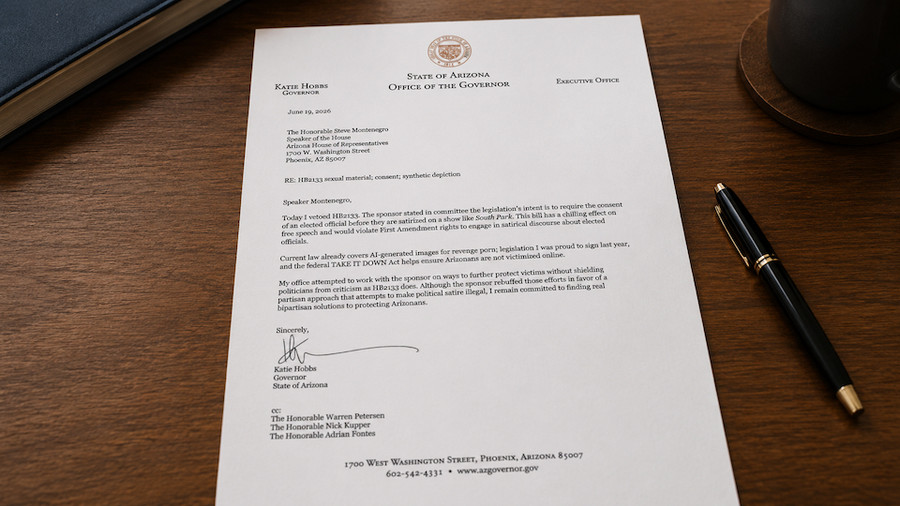
On Friday, June 19, 2026, Arizona Governor Katie Hobbs vetoed HB 2133, the "Protect Act," a bill that paired a crackdown on nonconsensual and AI-generated intimate imagery with sweeping new verification and consent requirements for adult websites. Under the bill, adult sites would have been required to use "reasonable" methods to verify that every individual depicted in sexual material was over 18 and had consented, and to retain those records for at least seven years.
Why It Matters
The Protect Act fight illustrates a 2026 inflection point: lawmakers increasingly bolt adult-industry-style consent and age-verification mandates onto deepfake bills, exporting protocols built for professional adult studios onto the entire internet. The veto signals that even consensus-friendly "think of the victims" framing can collapse when the fine print threatens to make platforms — adult and mainstream alike — legally unworkable. For operators, it's a reminder that record-retention and consent-documentation requirements are now the central battleground of state-level adult regulation, even as 26+ states have separately enacted age-verification laws.Notably, the Free Speech Coalition (FSC) — the adult industry's trade association — had worked with the bill's sponsor, Rep. Kupper, to strip out an earlier "catch-22" clause that simultaneously demanded model age verification yet forbade producers from retaining the identifying information needed to prove it, a contradiction that would have made lawful operation in Arizona impossible. After amendments, the age-and-consent provisions largely mirrored protocols the regulated adult industry already follows. FSC Director of Public Policy Mike Stabile told XBIZ the bill "would have applied the consent and age-verification protocols that the adult industry uses to all platforms globally," and suggested mainstream tech and media companies balked at having those "more intensive protocols" applied to them.
The veto is a rare instance of an adult-content regulation dying not over First Amendment objections from civil-liberties groups, but amid friction between the niche adult sector — which already documents consent and age — and mainstream platforms wary of inheriting its compliance burden. Supporters framed the bill as anti-revenge-porn and anti-deepfake legislation; the governor's office and critics flagged its broader operational consequences.
Sources
- Arizona Governor Vetoes 'Protect Act' With New Consent Provisions — XBIZ
- Arizona Governor Vetoes the State's 'Protect Act' — AVN
- Hobbs Vetoes Bill to Stop Child and Revenge Porn — Arizona Daily Independent
Update — 2026-06-25
Initial entry — story first created.