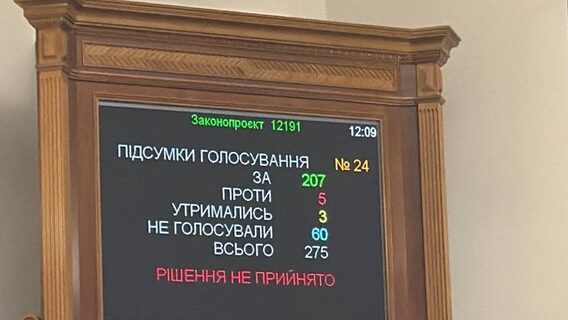
On May 28, 2026, Ukraine's parliament, the Verkhovna Rada, rejected Bill No. 12191, which would have decriminalized the production, distribution, and sale of pornography by consenting adults. The measure drew 207 votes — short of the 226 needed to pass — and lawmakers also declined to send it forward for a second reading, leaving Ukraine's Soviet-era ban firmly in place.
Why It Matters
Ukraine is one of the few European countries that still criminalizes consensual adult pornography outright, and its sizable cohort of OnlyFans and webcam creators operates in a gray zone that suppresses tax revenue and pushes earnings underground. The failed vote keeps that mismatch alive: a government courting platform tax dollars while its laws threaten the very people generating them. It also underscores how creator-economy policy is increasingly a fiscal and labor question, not just a morality one — and how slim parliamentary margins (just 19 votes here) can freeze reform that much of the industry views as inevitable.Under the current Article 301 of the Criminal Code, virtually any production, storage, or distribution of pornographic material is a crime carrying prison terms. Bill No. 12191, authored by People's Deputy Yaroslav Zheleznyak and colleagues on the law-enforcement committee, proposed to flip that framework: it would have decriminalized consensual adult content while sharpening penalties for offenses involving minors, including compelling children to participate in pornographic works. Sponsors stressed the bill did nothing to legalize child sexual abuse material, revenge porn, or non-consensual deepfakes.
Backers framed the reform as resolving an absurd contradiction in Ukrainian law. The state actively seeks to tax digital content platforms and the creators who use them, yet those same creators risk imprisonment for the work being taxed. By one estimate cited in support of the bill, Ukrainian OnlyFans creators declare only about 5% of their earnings out of fear of prosecution, costing the treasury roughly 905 million hryvnia in foregone 2023 revenue alone.
The vote is a setback for a creator economy that has grown briskly despite — or in defiance of — the criminal statute. Ukraine has repeatedly flirted with reform: a public petition on decriminalization earlier cleared the threshold that forced a presidential response, and the issue has recurred in the Rada for years. For now, the legal limbo continues, with creators monetizing on global platforms while remaining technically exposed at home.
Sources
- Rada rejects bill on decriminalization of pornography
- The Rada has defeated the bill on decriminalizing pornography in Ukraine
Update — 2026-05-29
{Initial entry — story first created.}
Update — 2026-09-08
The bill is back, and this time it is passing. XBIZ reported on September 6, 2026 that the Verkhovna Rada is again considering decriminalization — not a revival of the defeated Bill No. 12191, but a successor, Draft law No. 15294, introduced by the same author, People's Deputy Yaroslav Zheleznyak, in March 2026 before the earlier attempt even failed. Where the May vote drew only 207 of the 226 required, the new bill has cleared its first roll-call with 231 legislators in support. If it survives subsequent readings it goes to President Volodymyr Zelensky, who has previously declined to state a position and said he would wait for the legislative process.
The substance is largely unchanged: replace the blanket ban with a statute that specifies and in some cases increases penalties for CSAM, for material produced without participants' consent, and for distribution to minors, while removing criminal liability for consensual adult material made by and for adults.
What has changed is the framing. A Wall Street Journal report published the weekend of September 5-6 recast the initiative as wartime revenue policy rather than a rights question, and that reframing appears to be what moved the votes. Zheleznyak, who chairs Parliament's finance committee, estimates taxing the sector could yield up to $25 million a year — a rounding error against Ukraine's roughly $120 billion annual defence requirement, but enough, in the arithmetic being quoted across coverage, to fund on the order of 30,000 drones. Fenix International data cited in that reporting shows about 7,900 Ukrainian creators earned more than $131 million on OnlyFans in 2023, income the tax authority has pursued even as the underlying work remained a criminal offence carrying penalties reported at up to seven years.
The enforcement backdrop has also deteriorated in a way that helps the bill. This latest push comes amid reports of intensified tax enforcement against Ukrainian creators and a scandal involving press-police officials accused of taking bribes to overlook production and distribution — the predictable output of a law that criminalizes an industry the state simultaneously invoices. As tax lawyer Lesia Mykhalenko, who has represented more than 100 OnlyFans models, put it to the WSJ: "This is a victimless crime. It unnecessarily burdens the legal system at a time when we should be focused on defending the country."
For the creator economy, the significance is that the winning argument was fiscal, not moral. A government that could not pass decriminalization as a matter of rights is on track to pass it as a matter of revenue — a template other jurisdictions with large gray-market creator populations will notice.
New Sources
- Ukrainian Legislators Revive Porn Decriminalization Push — XBIZ
- OnlyFans, Taxes And Jail: Why Ukraine Wants To Legalise Pornography — Outlook India
Update — 2026-09-29
The fiscal case has gone mainstream, and the second reading is on the calendar. The Washington Post (Francesca Ebel and Anastacia Galouchka, September 25, 2026) and the New York Post (September 26) ran major features on Draft Law No. 15294. They framed decriminalization plainly as war financing. Per the New York Post, the second reading is on the agenda for the current legislative session, which runs through February. That follows a first reading this summer that the Post puts at 231–8.
The new reporting adds numbers. Citing data Ukraine's State Tax Service obtained from OnlyFans' UK parent, the New York Post reports that about 7,900 Ukrainian OnlyFans creators earned more than $131 million in 2023. The tax service estimates decriminalization would bring in about $25 million a year in tax revenue. Co-author Yaroslav Zhelezniak says that could buy 30,000 drones, and lawmakers have cited it against a $27 billion budget gap. "Ask yourself … who benefits," Zhelezniak said during the first reading. "Unfortunately, it's not the Ukrainian state budget … all that money remains in the shadow economy." The Post also lists Ukraine among a few European countries where producing or possessing any pornography is still a criminal offence, punishable by up to seven years, alongside Bulgaria, Iceland, Lithuania, Belarus and Russia.
The coverage also puts a face on the bill. Per the New York Post's account of the Washington Post reporting, the push grew out of a petition from creator Svitlana Dvornikova, who says she has about 1 million subscribers. She said tax authorities asked her to pay about $900,000 on her 2024 income and then used her filings to raid her home, seize her electronics and file criminal charges. The petition passed the 25,000-signature threshold that requires a presidential response, and her criminal case is paused while the bill moves. "We paid these taxes with one eye open, suspecting it might end badly," she told the Post.
What changed: the story has moved from a niche legislative item to international coverage built on the war-financing argument. That makes the second reading harder to quietly shelve. If it passes, Ukraine becomes the clearest example yet of a government legalising a creator economy mainly to tax it, a template worth watching in other jurisdictions with large gray-market creator populations.
New Sources
- Ukraine weighs legalizing pornography to raise tax revenue and buy drones — The Washington Post
- Ukraine weighing decriminalizing porn to generate tax revenue for war with Russia — New York Post
Update — 2026-10-08
A Kyiv economist is skeptical of the "30,000 drones" figure. An October 6, 2026 report by Mariana Lastovyria in The Counteroffensive, an independent Kyiv newsroom, questions the war-financing argument behind Draft Law No. 15294. It cites Bohdan Slutskyi of the Center for Economic Strategy, an economist who publicly supports the bill. Slutskyi estimates the industry, including webcam services and other platforms, employs 16,000–23,000 Ukrainians with combined annual income of 7–11 billion hryvnias ($150–245M). He expects legalization to add only 200–500 million hryvnias ($4.5–11M) a year, and says most of that would go to community budgets rather than the state budget. That is well below the State Tax Service's widely cited $25M estimate. Slutskyi sees the bill mainly as a way to fix a contradiction: the state asks creators to declare and pay tax on foreign income, then can use those filings as evidence of a crime.
The report also describes the human side. A creator using the pseudonym Sofya Owl says she helped raise about $78,000 for the military through "TerOnlyFans," a wartime movement in which donors to military fundraisers received nudes in return. The movement raised about $800,000 overall before authorities began raiding top-earning creators in fall 2024. The outlet notes the bill, now being prepared for its second reading, would decriminalize consensual adult content and strengthen child-exploitation protections. It does not propose specific regulation of the industry, which critics say could leave creators exposed to abuse. Kathimerini's September 28 summary confirms the first reading passed 231–8 in July, that current law allows sentences of up to seven years, and that the bill remains on the agenda for the session running through February.
What changed: The fiscal case is now contested by an expert who supports the bill. That makes the second-reading argument less about revenue and more about legal coherence and creator safety. An honest pitch now reads: "stop criminalizing taxpayers," not "fund the drones."
New Sources
- Porn decriminalization to fund the war effort? — The Counteroffensive with Tim Mak (Oct 6, 2026)
- Ukraine eyes porn decriminalisation as new source of war tax revenue — Kathimerini Cyprus (Sept 28, 2026)
Update — 2026-10-24
The ban is being used for extortion, creators' lawyer says. On October 23, 2026, IBTimes UK, citing reporting by the Kyiv Independent, said some Ukrainian police officers demand bribes of $200 to $30,000 from adult-content creators. The source is Lesia Mykhalenko, a lawyer who represents creators. She describes armed officers entering homes, pinning creators to the floor and pressuring them to sign confessions, either to extract a payment or to close a case quickly. She says about 95% of those targeted are women, mostly young. A former creator using the pseudonym "Velma" described a colleague being dragged into a car and given three days to pay. Opendatabot figures cited in the report show prosecutors opened almost 1,500 such cases in the first nine months of 2025, up 13% year on year. Penalties reach Hr 85,000 (about $1,800) in fines or seven years in prison. Policy expert Ihor Samokhodskyi, who helped draft the 2022 decriminalization bill, compared the ban's use to Soviet-era pressure on dissidents: "It allows you to persecute who you want to persecute." The report adds that several senior police officers in western and central Ukraine were arrested in May for allegedly taking bribes to protect adult studios. The Kyiv Independent piece carried no police response.
Where the bill stands. Draft Law No. 15294 passed its first reading 231–8 (three abstentions) on July 14 and still needs a second reading. Tax committee chair Danylo Hetmantsev says support isn't strong enough to guarantee passage, and former PM Yulia Tymoshenko has warned it would "turn Ukraine into Pornhub." Sponsor Yaroslav Zhelezniak says 5,000 Ukrainian creators earned $123M on OnlyFans between 2020 and 2022. A separate October 22 IBTimes piece puts 2023 earnings at more than $131M across nearly 7,900 creators and notes that a petition on President Zelensky's official site attracted more than 25,000 signatures calling for the government to reconsider how it treats adult creators.
What changed: Our October 8 update found the fiscal argument ("fund the drones") weakening. The case for the bill is now mostly about ending a corruption opportunity: a criminal ban on income the state also taxes gives police leverage to extract payments. That argument is harder for opponents to wave away, and it lines up with the India and Czechia court rulings this week that separate consensual sex work from crime. Platforms and payment providers serving Ukrainian creators should watch whether the second reading reaches the floor before the session ends in February.