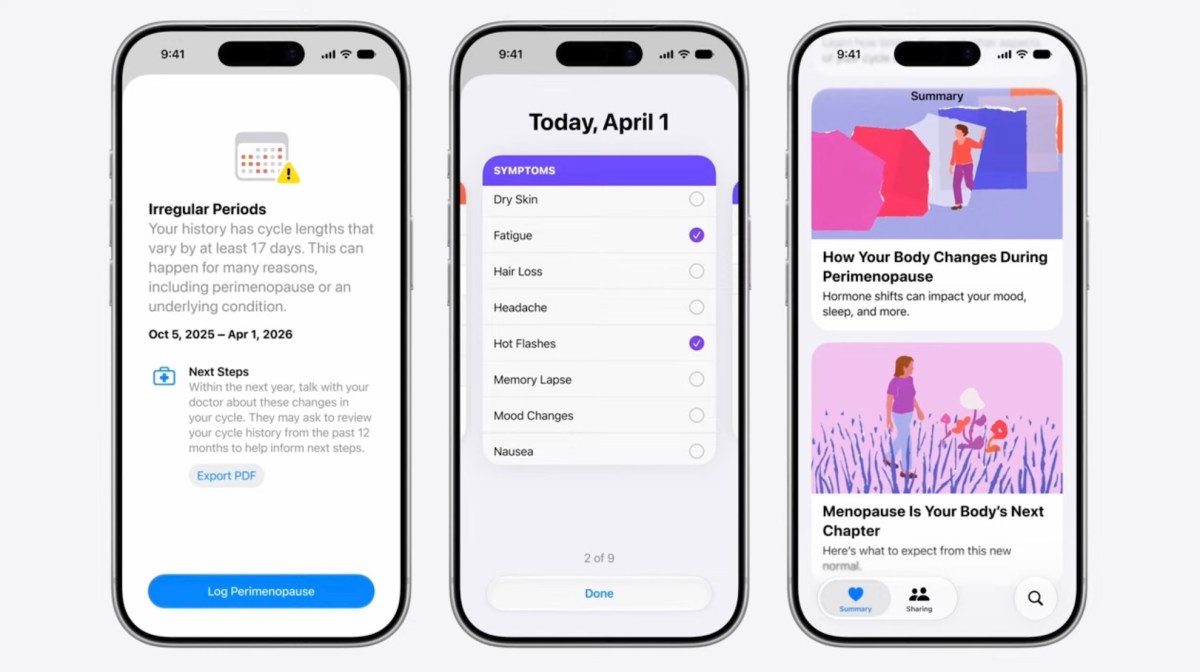
On June 8, 2026, Apple confirmed that its Health app will be able to tell users when they may be entering perimenopause, extending the platform's existing menopause features to the messy, often years-long transition that precedes it. The capability — reported by TechCrunch and CNET alongside Apple's broader WWDC 2026 software preview — uses cycle-tracking data logged on iPhone and Apple Watch to surface a perimenopause notification and prompt users toward relevant health information and conversations with clinicians.
Why It Matters
Apple normalizing perimenopause detection does two things at once: it expands the addressable market for midlife sexual and reproductive wellness by helping people recognize the transition earlier, and it compresses the differentiation available to standalone femtech apps whose core feature was cycle-pattern analysis. For brands selling lubricants, vaginal-moisture products, libido support, and menopause-specific devices, an Apple-scale "you may be in perimenopause" prompt is a potential top-of-funnel gift — millions of newly self-aware consumers entering the category. For femtech startups, it's a warning that platform owners can absorb baseline features and force the independents up-market into hormone sensing, clinical care, and treatment. And for privacy advocates, it's another reminder that the most intimate health signals are increasingly inferred by the devices in our pockets.Perimenopause has historically been a blind spot in both medicine and femtech. Symptoms — irregular cycles, sleep disruption, mood shifts, vaginal dryness, changes in libido — can begin in a person's late 30s or 40s and persist for years before menopause is clinically confirmed (defined as 12 consecutive months without a period). Because the phase is defined by variability rather than a clean endpoint, many people cycle through it without a name for what's happening. By analyzing logged cycle data for the irregularity patterns characteristic of the transition, Apple is positioning the Health app as a first-line signal that nudges users to seek care earlier.
The move plants one of the world's largest consumer-tech platforms squarely in territory that dedicated femtech companies have been building toward for years. Natural Cycles launched a dedicated perimenopause algorithm and its NC Band wearable in early 2026; startups like Clair Health ($11.6M raised in June 2026) are chasing continuous hormone sensing; and a wave of menopause-care brands have built businesses around the underserved midlife market. Apple's entry validates the category's size — but also raises the competitive stakes, since a free, pre-installed feature on hundreds of millions of devices reshapes consumer expectations about what basic cycle tracking should include.
It also reopens the privacy questions that have shadowed reproductive-health data since the Dobbs decision. Apple has historically leaned on on-device processing and encryption as a differentiator, and reproductive-health data is among the most sensitive a person can generate. How perimenopause inferences are stored, whether they sync to iCloud, and how they interact with law-enforcement requests will all matter to a user base that has grown wary of intimate health data living in the cloud.
Sources
- Apple's Health app can now tell you if you're in perimenopause — TechCrunch
- Here's everything new in iOS 27 and more, per Apple's keynote list (includes Health perimenopause support) — 9to5Mac
Update — 2026-06-27
Initial entry — story first created.