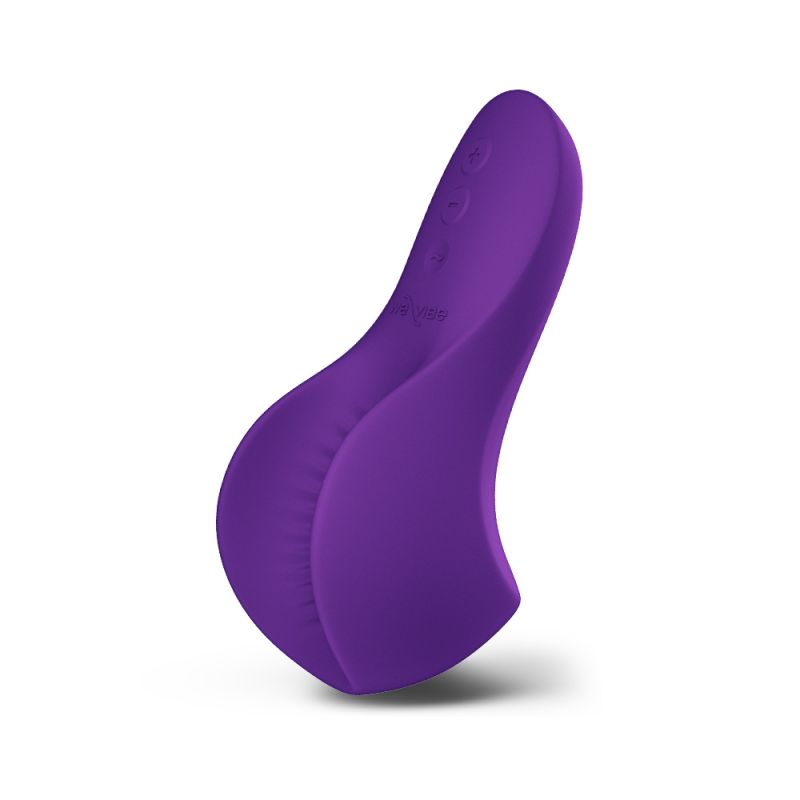
On August 19, 2026, SEXTECHGUIDE reported that We-Vibe has launched Shared Touch, a £109 (about $129) double-sided couples vibrator designed to sit between partners' bodies rather than inside anyone. One face of the pad is a soft, open ribbed sleeve meant for the penis shaft to rub against; the other is a gently curved tip aimed at the clitoris. We-Vibe's own product page for the UK market lists it as new and describes it as a "double-sided couples grinding vibrator" built for foreplay, longer build-ups, and non-penetrative sex.
Why It Matters
The couples-device category has been stuck in a design cul-de-sac: nearly everything assumes penis-in-vagina intercourse as the base case and bolts vibration onto it. Shared Touch reframes the couples vibrator as a shared surface rather than a worn accessory, which quietly widens the addressable market to anyone whose sex doesn't center penetration. For retailers it's also an easier sell than a wearable — no fit anxiety, no sizing questions, one SKU that works for a lot of body combinations. Watch whether U.S. distribution catches up to the European launch in Q4, and whether competitors (Satisfyer, Lovense) fast-follow the grinding-pad format the way they did with air-pulse.Mechanically it is a deliberate departure from the category We-Vibe basically invented. The company's best-known couples products — Chorus, Sync, Pivot, Verge — are either C-shaped devices worn during penetration or cock-ring formats. Shared Touch is neither. It is a single 13.8 cm pad with a dedicated surface per partner, positioning it as a successor in spirit to the Touch X, the brand's multi-purpose vibrator that was also marketed as something you could slip between two people. Controls are three buttons on the body: plus and minus for ten intensity levels, and a third to cycle eight patterns (Vibrate, Pulse, Wave, Cha-cha, Tease, Ramp, Tempo, Massage). Runtime is roughly one hour per charge.
The connectivity story is standard-issue Lovehoney Group at this point: the device pairs with the We-Vibe App for remote control, long-distance handoff of that control to a partner, and pattern customization. More practically, it ships with a locked travel mode — the kind of unglamorous feature that says a lot about who a brand thinks is buying. Distribution is currently skewed toward Europe, with the product live on We-Vibe's UK and EU storefronts and only patchy presence on U.S. retail sites so far.
What makes Shared Touch commercially interesting is what it is not doing. Nearly every headline couples device of the last two years has chased either penetration-compatible wearables or app-driven long-distance play. Shared Touch is a bet on grinding, frottage, and mutual-masturbation-adjacent play as an under-served product category — a segment that maps neatly onto younger buyers who report more non-penetrative sex, onto couples navigating pain conditions or erectile variability, and onto same-sex and mixed-anatomy pairings that the C-shape format never fit well in the first place.
Sources
- We-Vibe's Shared Touch wedges a vibrator between partners, no penetration required — SEXTECHGUIDE
- We-Vibe Shared Touch — Double-Sided Couples Grinding Vibrator (official product page, UK)
Update — 2026-08-21
Initial entry — story first created.
Update — 2026-09-28
North American launch, with a survey attached. We-Vibe formally launched Shared Touch in North America on September 22, 2026 at $129 USD / $139 CAD, roughly a month after the European debut covered above. AVN reported the launch date; ETO confirmed distribution through Scala in Europe, and We-Vibe is routing vendor enquiries via the Lovehoney Group Partner Hub. The specs match the European unit — ten intensity levels, eight patterns, We-Vibe App connectivity with remote control, custom vibrations and music/ambient-responsive modes, body-safe silicone, IPX7, USB rechargeable, in purple and black. So the U.S. distribution question raised in the original story is now answered: it took about a month.
More useful than the launch itself is the survey We-Vibe built the campaign around, because it explains the product positioning. The company reports that 40% of respondents said foreplay typically lasts less than nine minutes, while 46% wished it lasted longer. When foreplay ran longer than usual, 77% reported greater anticipation and excitement, 67% felt a stronger sensual connection, and 60% said the overall experience became more intense. Among those able to assess the effect on orgasm, 86.5% of women and 77.2% of men said longer foreplay improved it to some degree, and 91% agreed it made them feel more connected to their partner. Standard caveats apply — this is brand-commissioned research with no published sample size or methodology, and the questions are built to land where the product sits.
The framing is the interesting part. A We-Vibe representative pitched it as an argument against novelty: "better sex does not always require a completely new routine; sometimes it starts with spending more time enjoying what already works," with Shared Touch "reframing foreplay not simply as a prelude, but as a shared experience in its own right." That is a notably modest claim for a couples device — not a new act, just more minutes of an existing one — and it is a smart retail script. A store associate can explain "this makes foreplay longer" in one sentence, which is more than can be said for most app-connected couples hardware.