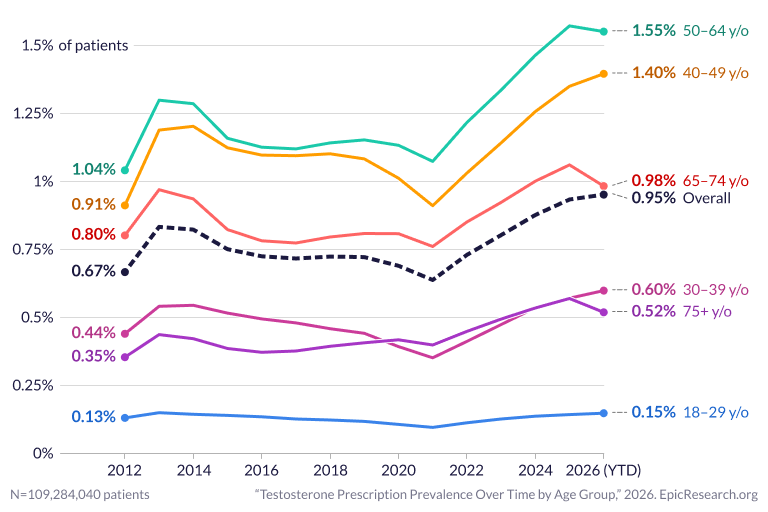
On July 29, 2026, Epic Research published a large-scale analysis showing that testosterone prescribing in the United States has not only recovered from a decade-long slump but pushed past its early-2010s peak. Drawing on records for 109 million men aged 18 and older with at least one healthcare encounter between January 2012 and June 2026, the study found the share of male patients on an active testosterone prescription fell from 0.83% in 2013 to a low of 0.64% in 2021 — then rebounded to 0.93% in 2025 and 0.95% in the partial first half of 2026, an all-time high across the study window.
Why It Matters
Testosterone replacement is the connective tissue between the "male sexual health" and "telehealth" segments of this industry, and a documented all-time-high prescribing rate validates the DTC thesis that companies like Hims and Ro have bet on. It also raises the regulatory stakes: a rising tide of prescriptions written through asynchronous online evaluation will draw fresh scrutiny to prescribing guidelines (which multiple 2026 analyses say are frequently ignored), to compounding-pharmacy peptide clinics, and to the FDA's broader TRT posture — including its April 2026 invitation for label expansion into low-libido indications. For investors, the Epic dataset is the clearest evidence yet that the warning-label removal was a genuine market catalyst, not just a talking point.The turnaround is broad rather than a niche-clinic quirk: every age group 30 and older surpassed its early-2010s peak by 2025. Men aged 50–64 carried the highest prevalence at 1.57% in 2025 (up from a prior peak of 1.30% in 2013), while men aged 18–29 remained lowest at 0.14%. That age gradient matters for the sextech and men's-health beat, because the 50–64 cohort is exactly the demographic that direct-to-consumer telehealth brands — Hims, Ro, and a wave of TRT-focused startups — have spent the last few years courting with low-friction online intake and home lab kits.
Epic's analysts tie the reversal to a specific regulatory inflection point. In March 2015 the FDA required labeling changes cautioning that testosterone products are not approved for age-related low testosterone and warning of possible heart-attack and stroke risk; prescribing declined in the years that followed. But in February 2025 the FDA removed the boxed cardiovascular warning from all testosterone products after the 2023 TRAVERSE trial found no increased risk of major adverse cardiac events among hypogonadal men with elevated cardiovascular risk. The warning removal, combined with the explosion of telehealth and DTC men's-health services, appears to have uncorked demand that had been suppressed for the better part of a decade.
The data lands amid a noisy cultural moment for testosterone — from Defense Secretary Pete Hegseth's push to screen troops for low T, to WSJ and Washington Post explainers on who actually needs testing. Epic's numbers cut through the noise with a clean population-level signal: whatever the messaging, real prescriptions are climbing fast, and the prescribing base is aging into the highest-risk-for-hypogonadism years.
Sources
- After Nearly a Decade-Long Decrease, Testosterone Prescribing Rates Rising Again — Epic Research
- Hegseth Wants a 'High-T' Military. Could That Pose Risks to Soldiers, or Society? — The New York Times
Update — 2026-08-04
{Initial entry — story first created.}