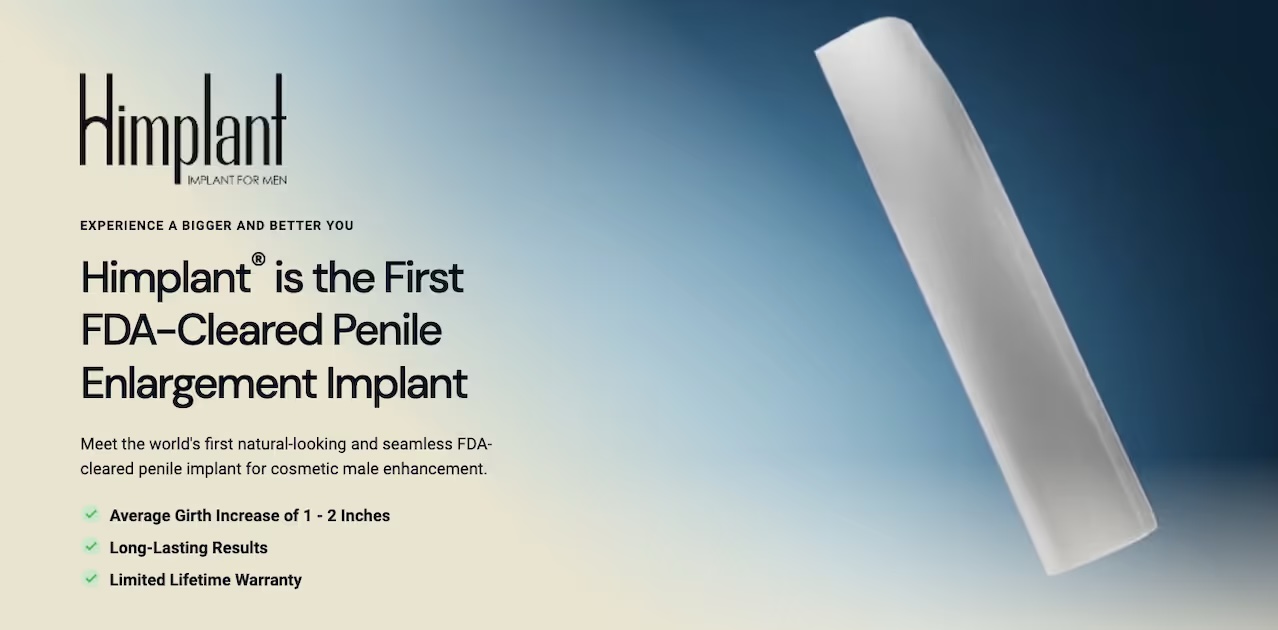
On October 5, 2026, the International Journal of Impotence Research (Nature Portfolio) published what its authors describe as a systematic review and single-arm meta-analysis of subcutaneous silicone penile sleeve implants. The devices covered are Penuma and Himplant, used to increase flaccid penile size and for some reconstructive indications. The authors are Hao Yang, Wenming Xiao, Hongquan Wang, Guoqiang Tang and colleagues, from the Department of Aesthetic Surgery at Dangdai Plastic Surgery Hospital and the Department of Urology at Fengdu County People's Hospital, both in Chongqing, China. They state that "the magnitude of dimensional change and complication profile have not been systematically quantified" until now.
Why It Matters
Cosmetic penile enhancement has become a cash-pay, direct-to-consumer procedure, sold through influencer marketing and medical-tourism listings. Until now, prospective patients and referring urologists mostly had company-reported outcomes to go on. This paper gives the first pooled, independent estimate, and it cuts both ways. The size gains are real and measurable. But a combined **~5% erosion/exposure rate and ~7% removal rate** is a meaningful risk for an elective procedure done on healthy tissue, especially since the evidence base is only four usable cohorts and almost no validated satisfaction data. For the men's-health telehealth and clinic sector, the takeaway is about how claims get worded. A product cleared through the FDA for a cosmetic indication and marketed on dimensional gains will increasingly be judged on outcomes that matter to patients, including erect size, sexual function and psychological wellbeing, which the literature has barely measured. Marketers who quote "inches gained" without the explant rate next to it should expect pushback from regulators and from plaintiffs' lawyers.Twelve publications from 2018 to 2026 met the inclusion criteria, but only four cohort studies were suitable for the primary meta-analysis. Pooled across them, the mean increase was 3.77 cm in flaccid girth and 2.94 cm in flaccid length. Pooled complication rates were 3.03% infection, 5.03% seroma, 5.12% erosion or implant exposure, 3.53% revision, and 7.08% explantation or removal, meaning roughly one patient in fourteen eventually had the device taken out.
The authors are careful about what the numbers show. The findings "are limited to flaccid penile dimensions and do not establish comparative effectiveness." Data on erect dimensions and patient-reported outcomes were limited, and "validated instruments [were] rarely used." They call for prospective comparative studies with standardised penile measurements, formal psychological assessment, validated outcome tools and longer follow-up. Separately, Penuma's own web domain now redirects to Himplant, which markets the product as an "FDA-cleared penile implant for cosmetic male enhancement."
Sources
- Subcutaneous penile silicone sleeve implants for penile augmentation: a systematic review and meta-analysis — International Journal of Impotence Research (Nature, published Oct 5, 2026)
- Himplant (formerly Penuma) — official site; penuma.com now redirects here
Update — 2026-10-06
Initial entry — story first created.