On August 19, 2026, the International Journal of Impotence Research published a virtual case study testing whether an anatomy-based decision-support tool can match experienced surgeons on one of the most consequential and least standardized calls in male sexual medicine: how to size and configure an inflatable penile prosthesis. The answer is a qualified yes — with the disagreements clustering in a specific and revealing place.
Why It Matters
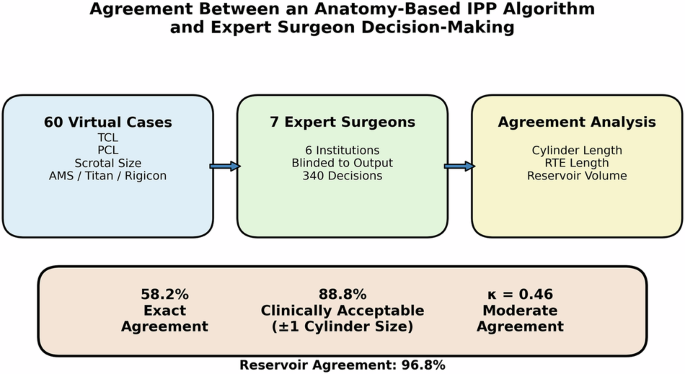
Penile implants are the definitive treatment for erectile dysfunction that has failed pills, injections and devices — and they are a real market, with three major manufacturers competing on cylinder design, reservoir profiles and pump ergonomics. But sizing has remained artisanal. Cylinder length that is too short compromises rigidity and girth at the glans; too long risks distal erosion and pain. Rear-tip extenders exist to fine-tune that fit, and this study shows they are the single largest source of variation between experienced hands. That is a quantified quality-of-care gap, and quality-of-care gaps are where digital tools get adopted. The realistic near-term application is not autonomous sizing but pre-operative planning and training: a structured baseline that a high-volume surgeon can override with reasons, and that a lower-volume surgeon can lean on. Given that implant outcomes drive both patient satisfaction and revision rates — the metric that determines whether a device line is profitable — manufacturers have obvious incentive to bundle configuration tools with their systems. The caveats are real and the authors name them. This was a virtual case model, not live surgery: no tissue feel, no intraoperative measurement, no patient in the room. Seven surgeons is a small panel. And the moderate inter-rater kappa cuts both ways — it means there is no clean gold standard to validate against, only a spread of expert opinion that the algorithm sits inside. The next study that matters is a prospective one measuring actual outcomes, not agreement.Researchers built 60 standardized virtual cases, each specifying total corporal length, proximal corporal length, scrotal size, and a predefined prosthesis model drawn from the three implants that dominate the market: the AMS 700 CX (Boston Scientific), the Titan (Coloplast) and the Infla10 (Rigicon). Seven experienced penile prosthesis surgeons from six institutions evaluated the cases independently and blinded to the tool's recommendations, selecting cylinder length, rear-tip extender and reservoir volume — generating 340 surgeon-case decisions in total. Their choices were then compared against output from the Canguven Penile Prosthesis Calculator.
Exact agreement between the calculator and surgeon-selected cylinder length occurred in 198 of 340 decisions (58.2%), rising to 302 of 340 (88.8%) within a clinically acceptable range of plus or minus one cylinder size. Mean absolute difference was 0.95 ± 1.18 cm, with discrepancies greater than 2 cm in 38 of 340 decisions (11.2%). Reservoir selection was near-unanimous at 329 of 340 decisions (96.8%).
The most useful finding is about the surgeons, not the software. Inter-rater agreement among the seven experts was only moderate — Fleiss' kappa of 0.46 (95% CI 0.41–0.51) — and pairwise agreement between the calculator and individual surgeons ranged from 0.43 to 0.55. In other words, the experts disagreed with each other about as much as they disagreed with the algorithm. The authors trace most of that variability to differing use of rear-tip extenders, describing the pattern as consistent but distinct surgeon-specific strategies rather than random noise. Their conclusion is deliberately modest: the algorithm shows moderate agreement with expert selections and may provide a structured anatomy-based framework for configuration planning while preserving individualized surgical judgment.
Sources
- Agreement between an anatomy-based inflatable penile prosthesis configuration algorithm and expert surgeon decision-making: a virtual case study — International Journal of Impotence Research
- Crossref record, DOI 10.1038/s41443-026-01346-0 — Crossref
Update — 2026-08-28
{Initial entry — story first created.}