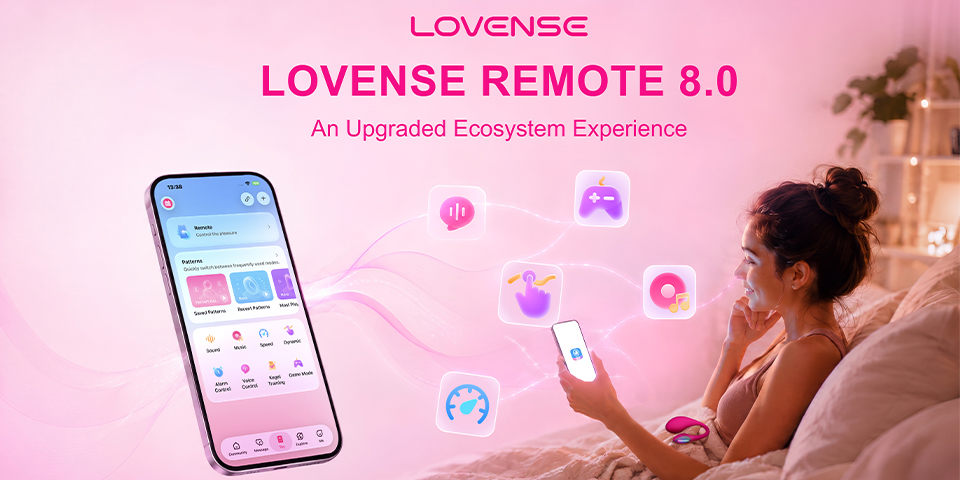
In late July 2026 — announced July 28 — Lovense released Remote 8.0, a major restructuring of the Remote app that reorganizes the software around five spaces: Community, Message, Toy, Explore and Me. The update reframes what has been the primary device-control interface for the Lovense ecosystem as something closer to a social and content platform, with hardware control persisting as one tab among several rather than the app's entire purpose.
Why It Matters
Connected-toy makers have run out of headroom on hardware differentiation, and the competition is moving to the software layer. The 2020–2025 teledildonics race was fought on motors, latency and app pairing speed. Those problems are now substantially solved and commoditized — a $59 device pairs in under three seconds and syncs to a partner across an ocean. What remains defensible is the network: the pattern library other users built, the community you're already in, the content catalog that syncs, the partner already on the platform. Every one of those is a switching cost that survives the next hardware generation. Reframing Remote from controller to ecosystem is a straightforward play for lock-in, and it is the same structural move Apple made with the App Store and Peloton made with classes. The persistent-control detail deserves particular attention from anyone building in this space, because it quietly reveals the usage pattern the company is optimizing for. Building an app so a device keeps running while the user browses content and chats means Lovense's data says those are simultaneous activities, and it means engagement time — not device runtime — is becoming the metric that matters. That is a media company's metric. Two risks travel with the strategy. First, community and messaging features inside an intimacy app dramatically expand the attack surface and the moderation burden. Lovense has a documented security history: researchers disclosed vulnerabilities in 2025 affecting a claimed 20 million-plus users, and the company's initial response — a proposed 14-month fix timeline, later compressed to two days under public pressure, followed by legal threats against the researchers — is not the track record you want going into a launch that adds user-to-user interaction. Second, app-store risk. An intimacy device controller occupies a tolerated niche in Apple's and Google's policies; a social network with user-generated content inside an adult-adjacent app is a materially harder review conversation. For the rest of the industry, the read-across is competitive positioning. If Lovense successfully converts app installs into a social graph, hardware-only rivals become suppliers into someone else's platform. Expect Satisfyer, LELO and the app-connected mid-market to respond with either their own community layers or interoperability arguments — and expect "open API" to start functioning as a marketing weapon aimed squarely at Lovense's walled garden.The most consequential engineering change is mundane on its face and revealing on reflection: persistent device control. When users navigate away from the main control panel, connected devices keep running while a floating control bubble stays available for intensity adjustments as they browse elsewhere in the app. Physical volume keys can also be used to change intensity directly. In other words, the app is now designed on the assumption that users will be doing something else in it while a device is running — browsing content, messaging, scrolling community posts. That is a fundamentally different product thesis than a remote control.
The rest of the update fills in that thesis. Lovense Bond provides a dedicated environment for community conversations and discovery; Patterns continues to let users share vibration patterns they've created and browse patterns contributed by others. Messaging, personal activity and interactive experiences are pulled into the same structure. CEO Dan Liu framed the release as ecosystem consolidation: "Remote 8.0 reflects our continued commitment to improving how users experience Lovense. By creating a clearer and more unified journey across control, content, interaction and community, this update strengthens the foundation for the continued evolution of the Lovense ecosystem."
Lovense is the natural company to attempt this. Following the WOW Tech merger it sits atop the largest pleasure-device portfolio in the industry — the Lovense-branded line plus We-Vibe and Womanizer — and its Remote app has been the connective tissue for cam-site integrations, long-distance partner control and interactive content sync for the better part of a decade. Remote 8.0 is less a new capability than an acknowledgment that the app itself, not any individual device, is the company's durable asset.
Sources
- Lovense Launches Remote 8.0 With an Upgraded Ecosystem Experience — EAN Online
- Lovense Rolls Out App Updates Including Revamped Ecosystem — XBIZ
- Lovense Launches Remote 8.0 With Upgraded Ecosystem Experience — AVN
Update — 2026-07-30
Initial entry — story first created.