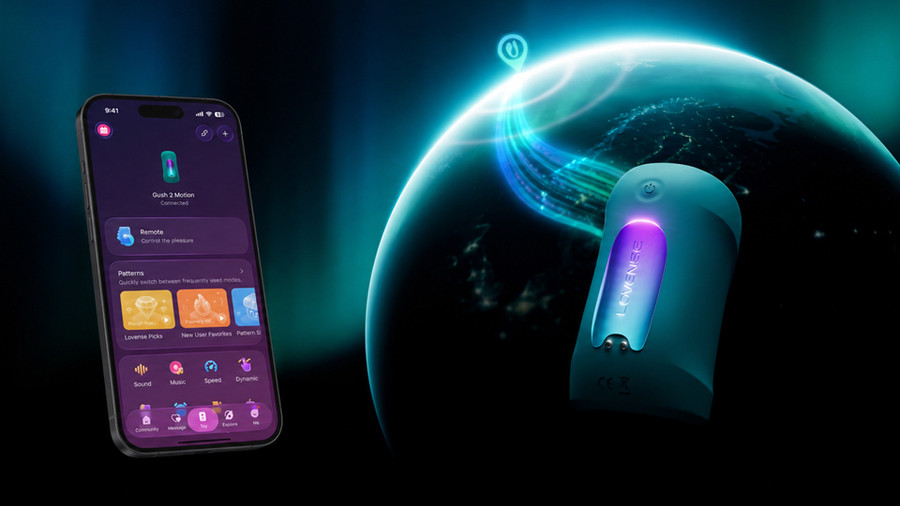
On August 5, 2026, Lovense introduced an updated version of its Gush 2 male masturbator that adds motion-sensing control — a built-in sensor that detects stroking speed and intensity in real time and translates that physical rhythm into a controllable signal. The Singapore-headquartered teledildonics maker says the device offers customizable oscillation and vibration settings tuned to stimulate the frenulum, generates ambient warmth, and can be operated either directly on the device or remotely through Lovense's app ecosystem.
Why It Matters
The male-device segment has been one of the fastest-growing corners of pleasure tech, and connected strokers are where the teledildonics category is investing hardest. Gush 2 Motion's headline feature — gesture-to-haptic translation — is a small but meaningful step from "remote control" toward genuine biofeedback-driven interaction, the same direction we're seeing across the category (Lovense's own Solace line, Kiiroo's Keon, and rival motion-aware devices). For long-distance couples and cam-industry integrations alike, converting a natural physical rhythm into a transmittable signal is exactly the kind of friction reduction that drives adoption. And Liu's "make the device listen, not instruct" framing is a telling design philosophy for connected sextech in 2026: as hardware matures, the competitive edge shifts from adding features to making the existing ones disappear into the experience.The design thesis is notably restrained for a company known for feature-dense gadgets. "We designed Gush 2 Motion around a simple idea; the body already knows what it wants," said Lovense CEO Dan Liu. "Instead of adding more buttons or menus, we made the device listen. It turns a familiar physical rhythm into a shared digital signal — one that can reach a partner in the same bed or on the other side of the planet. Connected intimacy should feel intuitive, not instructional." The original Gush 2 is a flexible, wrap-around stroker; the Motion upgrade keeps that form factor and grafts on gesture input.
The move fits a broader teledildonics trend toward making devices responsive rather than merely remote-controllable. Motion sensing lets one partner's real stroking cadence drive a synchronized device elsewhere, closing some of the latency and abstraction that has long made long-distance play feel more mechanical than intimate. Lovense's official product listing positions Gush 2 Motion squarely in its connected male-vibrator range, emphasizing app control and partner synchronization.
Sources
- Lovense Debuts Upgraded 'Gush 2' Motion Sensing Masturbator — XBIZ
- Lovense Gush 2 Motion: Remote-Controlled Male Penis Vibrator with Motion Sensing — Lovense (official product page)
Update — 2026-08-08
Initial entry — story first created.