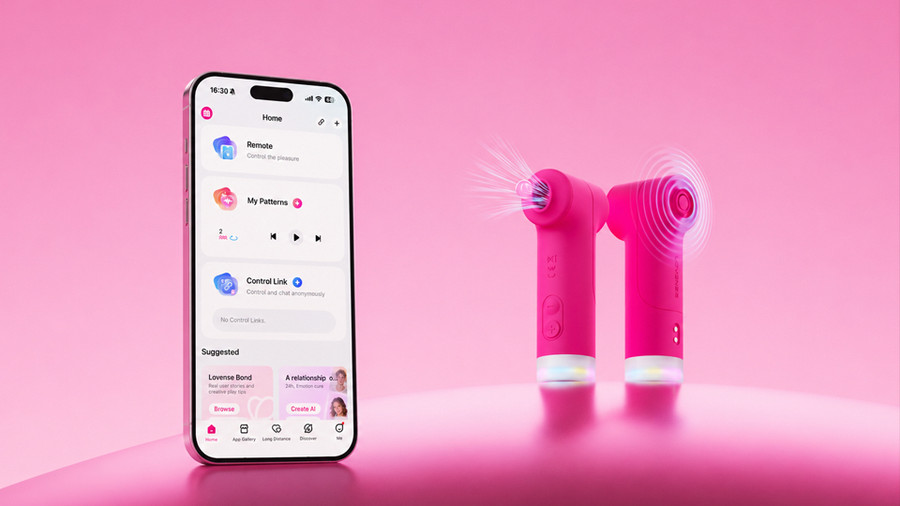
On July 20, 2026, Lovense released Fizz, a dual-head clitoral stimulator that pairs air-pulse suction with rhythmic tapping in a single app-connected device. The more interesting part isn't the hardware — it's the justification. Lovense is explicitly framing the two-mode design as a response to new anatomical research rather than the usual more-motors-more-better arms race.
Why It Matters
Air-pulse suction has been the dominant clitoral technology since Womanizer commercialized it, and the category's competitive response for years has been price compression and intensity escalation — cheaper suction, more suction, suction in a rose shape. Fizz is a bet that the next differentiation vector is *modality*, not power, and Lovense is unusually explicit about grounding that bet in anatomical literature rather than marketing intuition. That matters for the industry's credibility problem more than for any single SKU. Pleasure devices have historically been designed around folk anatomy and iterated by feel, in a category that received rigorous nerve mapping nearly three decades after the male equivalent. A major manufacturer citing a specific 2026 imaging study as its design brief — even a preprint, even self-servingly — is a small signal that R&D in this segment is starting to look like R&D. Buyers and reviewers should hold that standard: if brands want the authority that comes with citing science, the citations need to survive scrutiny. Expect competitors to follow with their own multi-modal designs; the "one sensation, one point of contact" era of suction toys is probably ending.The company points to a March 2026 study by neuroscientist Ju Young Lee and a team at Amsterdam University Medical Center, published on the preprint server bioRxiv, which used synchrotron radiation X-rays to produce what Lovense's representative described as the first complete 3D map of the nerve network within the human clitoral glans. According to the company's summary of the work, the clitoris's primary sensory pathways do not terminate at the visible glans; branches extend into surrounding structures including the hood, mons pubis, and labial area, and the dorsal nerve — the main sensory highway — does not weaken as it approaches the tip but continues at full capacity, branching across multiple tissue zones. Lovense also notes the equivalent nerve mapping for the penis was completed in 1998, 28 years earlier. (Worth flagging: bioRxiv is a preprint server, so the study has not necessarily completed peer review, and the anatomical claims here are relayed via Lovense's own reading of it.)
The product itself acts solely on the clitoral glans via a dual-head architecture: an air-pulse suction head with multiple intensity levels including ultra-gentle settings for gradual arousal building, plus a separate tapping head with variable settings, all controllable through the Lovense app. "For years, clitoral suction toys have focused on one sensation and one point of contact," said Lovense CEO Dan Liu. "Fizz was created around a simple idea: pleasure is not one-note. By combining focused suction, rhythmic tapping, and programmable app control, we want to give users more ways to explore what actually feels good for their bodies."
Sources
- Lovense Debuts 'Fizz' Stimulator — XBIZ
- Lovense Introduces 'Fizz' Dual-Mode Clitoral Stimulator — AVN
- Lovense Fizz product page
Update — 2026-07-28
Initial entry — story first created.
Update — 2026-08-07
Fizz moved into full retail rollout in early August 2026. On August 7, trade outlet JRL Charts reported (dateline Las Vegas) that Lovense is positioning Fizz to the B2B channel at $129 MSRP, launching globally, and pitching it to retailers as a two-technologies-in-one-device merchandising story — air-pulse on one head, rhythmic tapping on the other, with independent operation plus programmable sequences through the Lovense app. The wholesale framing (a "straightforward merchandising proposition") is notable: after debuting Fizz as a consumer product in July, Lovense is now working the retailer/distributor layer, consistent with its broader 2026 push into physical retail (the Hustler Hollywood in-store tour and the Remote 8.0 ecosystem play).
The JRL writeup again anchors the design to the Amsterdam UMC clitoral nerve-mapping research led by neuroscientist Ju Young Lee — the same 3D imaging work cited at launch — reinforcing that the anatomy-as-design-brief narrative is now Lovense's durable marketing spine for the product, not a one-off launch line.