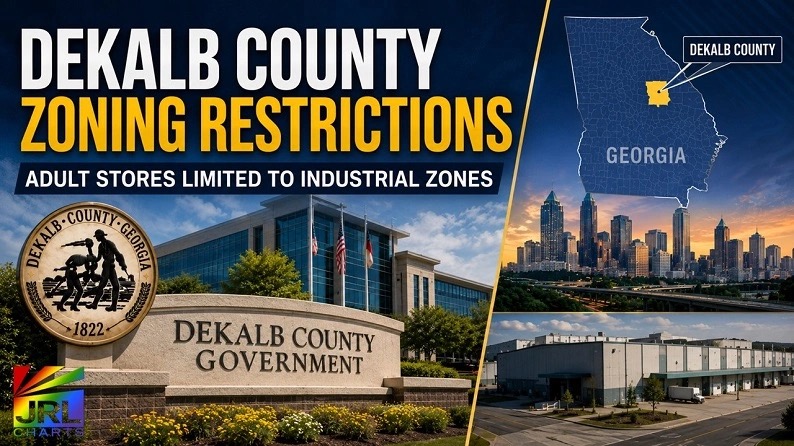
On August 11, 2026, the DeKalb County Board of Commissioners voted to adopt an ordinance barring adult establishments from commercial zoning districts in unincorporated DeKalb County, Georgia, restricting them going forward to industrial districts only. The county sits in metro Atlanta and is one of Georgia's largest, making this one of the more consequential local zoning shifts for adult retail this year.
Why It Matters
Pleasure-products retail has spent a decade earning mainstream shelf space — plusOne in 1,300 Ulta stores, Dame at Walmart, sexual wellness aisles at CVS. Local zoning is the quiet counterweight: even as the category normalizes at the SKU level, the *store* format that sells it exclusively can still be legislated to the edge of town. Note the asymmetry the DeKalb definition creates — a mass retailer stocking vibrators in a commercially zoned shopping center is untouched, while a dedicated shop selling the same products is an "adult establishment" bound for the industrial park. That is a structural advantage for mainstream and e-commerce channels over specialty brick-and-mortar, delivered without anyone debating the merits. Watch for two follow-ons: whether existing DeKalb operators are grandfathered or given an amortization period, and whether Tokyo Valentino — a chain with a long history of litigating Georgia adult-zoning rules — challenges the ordinance. Zoning fights are cheap to start, slow to resolve, and set templates that neighboring counties copy.The rewrite is presented as housekeeping. Deputy Director of Planning & Sustainability Rachel Bragg told commissioners that inconsistencies had been found between the county's zoning code and its adult-business licensing requirements, and that the primary change was to establish consistent definitions. "This is primarily a cleanup and coordination effort to make sure that we're using current terminology and applying it consistently throughout the different sections of the county code," Bragg said. The ordinance replaces the term "adult entertainment establishments" with "adult establishment," defined to cover strip clubs, businesses with private adult-video booths, and stores selling or renting adult books and videos. Bragg noted local governments may regulate adult establishments to address documented "secondary effects" such as prostitution and blight — the constitutional doctrine that has underpinned adult zoning law since Renton.
The backstory is less procedural. Last October, county officials revoked a building permit for Tokyo Valentino, an adult retailer building out a location at 1850 Lawrenceville Highway in Greater Decatur, saying the applications had not properly disclosed the intended use including the sale of sex toys — on a commercially zoned site. The county simultaneously imposed a 100-day moratorium on new adult stores, extended it in May, and was set to consider extending it again on August 11. Because the new ordinance passed, Bragg said, the moratorium can simply lapse when it expires September 3. Since October the planning department has worked with the county law department and an outside firm specializing in adult-business regulation to review the rules.
For operators, the practical effect is a shrunken map. Moving an entire retail category from commercial corridors into industrial districts cuts the number of viable sites, changes the foot-traffic profile entirely, and makes zoning diligence a gating item before any lease or acquisition. It also matters to landlords whose commercial properties previously carried zoning that could accommodate an adult tenant.
Sources
- DeKalb updates zoning rules for adult establishments — Decaturish
- DeKalb County Pushes Adult Stores Out of Commercial Zones in Major Zoning Shift — JRL Charts
Update — 2026-08-18
Initial entry — story first created.