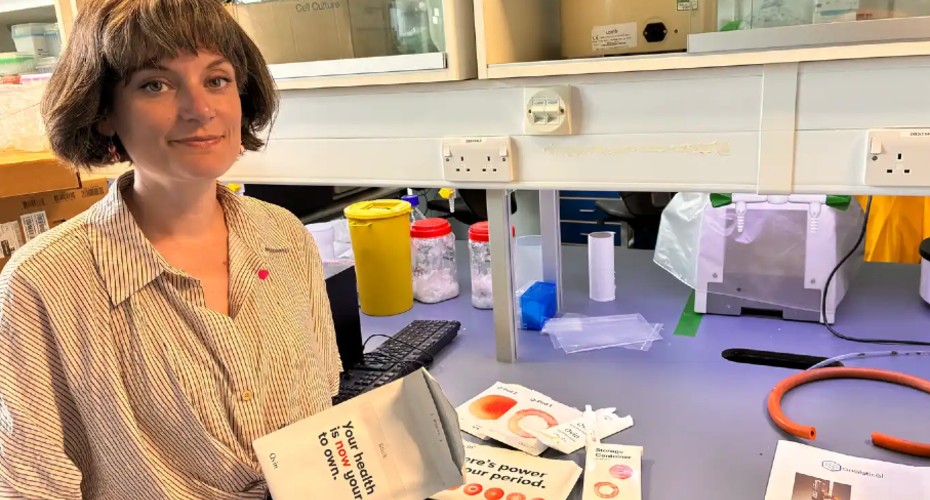
On August 26, 2026, the University of Exeter announced CycleTrack, a study with the University of Bristol that will build what the researchers describe as the world's largest biobank of menstrual fluid — collected from thousands of participants in their mid-30s across three menstrual cycles using specially designed period pads, paired with a daily tracking app and detailed questionnaires. The BBC covered it the same day as a potential "game changer" for heavy periods and endometriosis.
Why It Matters
Menstrual fluid has historically been medical waste; treating it as a diagnostic substrate is the interesting move, and one a handful of femtech companies have already commercialized on thin evidence. Daye's diagnostic tampon and a range of at-home hormone and microbiome tests all depend on the premise that menstrual effluent carries usable clinical signal — a premise that has never had a population-scale, genetically-linked dataset behind it. CycleTrack would supply one. For femtech founders and investors, that is the difference between a wellness claim and a regulatory pathway: biomarker validation at cohort scale is what turns a consumer test into a reimbursable diagnostic. The five-years-to-five-months target is also a rare instance of a research programme publishing the metric it expects to be judged on, which makes it unusually easy to hold accountable.The methodological advantage is the cohort, not the biobank. Participants are drawn from two long-running UK birth cohort studies — Children of the 90s and Born in Bradford — which means the menstrual fluid samples arrive attached to decades of longitudinal health and genetic data. That combination is what makes the design unusual: most menstrual health research collects symptoms or biology, rarely both, and almost never with a life-course record behind it. Researchers hope to identify biological signals linked to variation in periods and related conditions, supporting earlier diagnosis, better care plans, and tools to flag risks such as iron deficiency.
Professor Gemma Sharp of the University of Exeter framed the gap plainly: "We know that menstrual health is a key indicator of overall health, but a lack of high-quality data means it remains poorly understood and under-supported in healthcare." She cited her group's own prior finding of an association between heavy periods, school attendance and lower GCSE attainment as evidence that the downstream costs are measurable and largely unmeasured.
CycleTrack sits inside The Missed Vital Sign, a programme led by Wellcome Leap with an explicitly quantified target: reducing the time from onset to effective treatment for heavy menstrual bleeding from five years to five months. A participant from the Children of the 90s cohort, identified as Alice, described the pathway the programme is trying to compress — heavy, painful periods from age 15 that she assumed were normal, unmanageable pain by 24, an eventual endometriosis diagnosis and multiple surgeries.
Sources
- World's largest menstrual fluid biobank will transform understanding of menstrual health — University of Exeter
- Major UK study could be a 'game-changer' for heavy periods and endometriosis — FemTech World
Update — 2026-08-27
{Initial entry — story first created.}