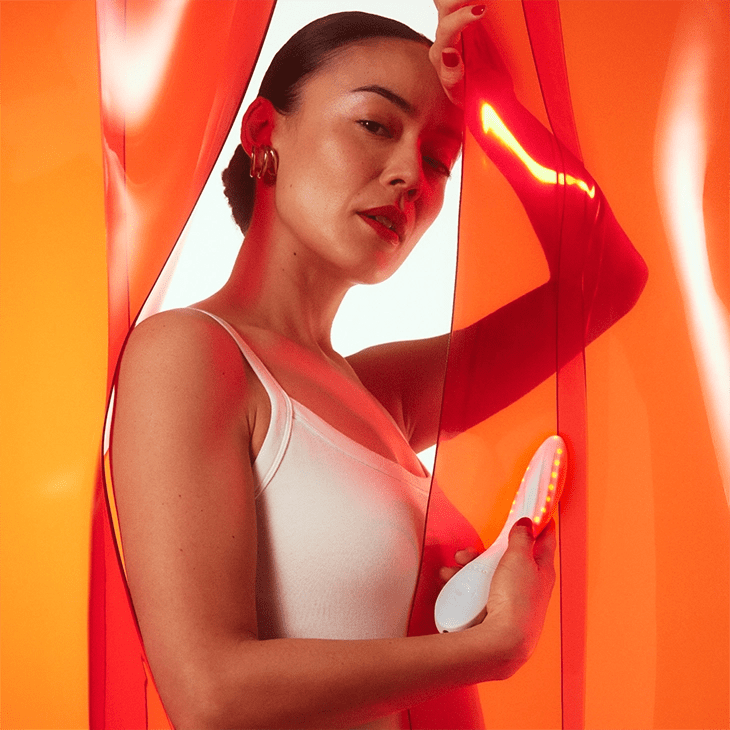
What it is: The LELO Mona Spectra is the Swedish brand's newest addition to its long-running Mona line of G-spot vibrators, and the first to build LED light therapy into the wand itself. LELO markets it as a "red light intimate wellness massager." It arrived in mid-2026 and retails for $299 on LELO's site, with availability also via Amazon.
Why It Matters
Red light therapy has completed the full wellness-trend migration — dermatology clinic to LED face mask to, now, the sex toy drawer — and the Mona Spectra is a test case for how the pleasure industry handles quasi-clinical claims. LELO's positioning is legally careful (explicitly not a medical device, no medical claims) while the marketing copy talks about collagen production and tissue vitality, which is precisely the gray zone the FDA's wellness-device enforcement discretion permits. The healthy development is that the trade press is now routinely running these claims past actual dermatologists and getting on-the-record skepticism. That's the kind of scrutiny mainstream consumer categories get, and the pleasure category is better off for it — especially as more brands reach for biofeedback, light, and "clinically inspired" language to justify $300 price points.What makes it different: Everything the Mona line already does — internal G-spot stimulation, body-safe silicone, waterproofing, app connectivity that unlocks two extra intensity settings — plus emitters that put near-infrared (850nm), green (525–535nm), and blue (465–475nm) light where you'd normally just get vibration. This version also adds sensorial ribbing along the shaft. LELO's product page claims the light "stimulates collagen and elastin production, supports tissue elasticity, natural lubrication and sensitivity," and that thermal energy from the LED increases blood flow. The company attributes anti-inflammatory effects to the blue light and a calming, hyperpigmentation-related effect to green.
What reviewers and experts are saying: This is where it gets interesting, and where a buyer should slow down. Mashable's Anna Iovine took LELO's claims to Dr. Shoshana Marmon, assistant professor of dermatology and director of clinical research at New York Medical College and chair of the AAD's Menopause and Women's Health in Dermatology group. Marmon's verdict (July 24, 2026): red light therapy has genuine, if dose-dependent, evidence behind it in dermatology for wrinkles, acne, hair growth, and wound healing — but LELO's claims here "seem to go beyond what has been studied." The limited vaginal research has focused on postmenopausal women with genitourinary syndrome of menopause (GSM); a few studies suggest red light may improve some GSM symptoms, but "most studies have been small, lacked a placebo group or focused on urinary incontinence. The research has not established that red light improves sexual sensitivity, and it has not been meaningfully studied in healthy women without GSM."
LELO, for its part, told Mashable the underlying technology is supported by a substantial body of research, acknowledged the evidence for chronic pain and athletic recovery is "inconclusive or mixed," and was clear that the Mona Spectra "isn't a medical device" and that no medical claims are being made — it's "designed strictly as a wellness and pleasure device." The company says it has a customer-experience study underway in Spain. VICE (July 13, 2026) was warmer but landed in the same place, noting that LELO hasn't disclosed the device's irradiance level — the spec that actually determines how much light reaches tissue — and that they'd "love to see a thorough sex study that supports this as a legitimate, at-home treatment."
Price and where to buy: $299 direct from LELO, also listed at Amazon.
Materials and safety: Body-safe silicone, waterproof, USB rechargeable, app-connected. Per the American Academy of Dermatology, short-term red light therapy use is considered safe — the concern here is efficacy, not harm.
The bottom line: If you already wanted a premium app-connected G-spot wand and the light show is a bonus, the underlying Mona is a well-established design and the ribbing is a real upgrade. If you're buying it for the red light — expecting improved lubrication, tissue elasticity, or heightened sensitivity — understand you're paying a significant premium for an unproven benefit. Two experts consulted independently by two outlets said the same thing: the claims outrun the evidence. Buy it as a nice vibrator with an interesting experiment attached, not as a treatment. And if you have actual GSM symptoms, that's a conversation for your clinician, not a $299 impulse purchase.
Sources
- We asked a doctor about that new red light sex toy — Mashable
- LELO's Mona Spectra Brings Red Light Therapy to Your Sex Toy Drawer — VICE
Update — 2026-07-28
Initial entry — story first created.
Update — 2026-09-11
The first real hands-on review is in, and it splits the difference exactly where the skeptics predicted. On September 9, 2026, VICE published a full tested review of the Mona Spectra by Maha Haq — the first independent hands-on account of this specific model, following the launch-coverage skepticism logged in this story's original entry. Her verdict, condensed: it is a very good $299 vibrator with a light show attached, and you should buy it for the first thing, not the second.
What she liked. The silicone, first and most emphatically — smooth enough that she skipped lube entirely on both test sessions despite LELO including a packet in the box. The device is about 7.7 inches long with just over 4 inches insertable, fully waterproof, with 16 intensity levels and eight named vibration patterns plus on-handle controls that don't require the phone. Battery held up across 40 minutes of use against LELO's claimed two-hour runtime. The app turned out to be more useful than she expected, including motion-based modes ("Screwing," "Shaking," "Swiping") and a one-minute cleaning cycle. She also noted the warmth, which comes off the LED array rather than a dedicated heating element, worked well as a pre-sex warm-up.
On the light claims — the substantive part. Haq went in skeptical and came out qualified rather than dismissive. She cites a 2026 randomized placebo-controlled trial of 65 postmenopausal women in which photobiomodulation helped with vaginal dryness, burning and urinary leakage but did not significantly improve sexual function versus placebo, with the researchers calling for more study. She also notes another recent study delivered red light to 27 postmenopausal women via eight weekly 30-minute sessions with a dedicated vaginal light probe — a materially different dosing regime from using a vibrator at home twice. Her framing lands on irradiance: the general science may hold, but that "doesn't automatically mean every red-light device is delivering enough light, for long enough, to create the same results." Her bottom line on the red LEDs: "I'm definitely not going to tell you my collagen is thriving."
Blue and green get a harder look. She points to a 2024 randomized trial of 60 women with recurrent vulvovaginal candidiasis where adding blue LED to standard antifungal treatment reduced Candida counts more than antifungals alone — while stressing that is a narrow clinical use case and "definitely not a reason to start treating a yeast infection with your vibrator." On green, she notes LELO's own materials concede it is not a recognized or common treatment for vaginal rejuvenation. Asked whether she could feel any difference between the three colors: no. "They mostly just felt like different colored lights."
Two new specifics worth logging. The charger is still USB-A on the power end, which Haq calls out as behind the times at a $299 price point in 2026. And LELO is discounting: code SPECTRA10 takes an additional 10% off at LELO.com through October 15, stackable but not applicable to bundles.
Category context. The Daily Beast's Looker covered the broader red-light-sex-toy wave on September 4, placing Mona Spectra alongside Joylux's $395 Rose Gold vFit (red LED plus a warming function, sold with a monthly payment plan) and Private Gym's $280 Optimus, a penis pump wrap that folds red light into a vacuum device. Red light therapy is now a multi-billion-dollar beauty category migrating wholesale into sexual wellness — which means the irradiance question Haq raises is about to apply to a lot more than one wand.
New Sources
- LELO Mona Spectra Review: A $299 Red Light Vibrator, Tested — VICE
- These Red Light-Powered Vibrators Aim to Combine Sex and Wellness — The Daily Beast (The Looker)
Update — 2026-10-01
The first full mainstream review is in, and it's positive. On September 28, 2026, Women's Health published a hands-on review in which an editor tested the Mona Spectra and called it "the ultimate tool in sexual self-care." The review confirms the $299 price and frames it as nearly $100 less than comparable red-light intimate devices such as the Joylux vFit. It lists the spec sheet: body-safe silicone over ABS, 8 vibration settings and 16 intensities, 4 inches insertable, about 2 hours of run time, and an automatic shutoff at 20 minutes. LED output is listed as red 1.4W, green 2.1W, blue 2.1W and near-infrared 0.45W, with the non-red modes unlocked through the LELO app.
The tester's feedback is practical. She liked the S-curve and ridges for G-spot use and the gentle warmth from the LEDs, and she found the recommended 15-minute sessions made solo play slower and more deliberate. The main complaint was the controls: red-light mode needs a double-click on the centre button, and the online manual explained it better than the paper one. The review also cites benefits from red-light therapy on vaginal tissue, such as moisture and pelvic-floor comfort. Read that alongside the July caution recorded above from dermatologist Dr. Shoshana Marmon, who said the research covers postmenopausal women with GSM and has not established benefits for sexual sensitivity in healthy users.
The marketing push: On September 30, PAPER covered LELO's red-lit "Spotlight on Pleasure" party at New York's Georgia Room, built around the Mona Spectra and Gen Z's supposed "sex recession." LELO is selling the device as a lifestyle object as much as a vibrator, with event discount codes (PAPER readers got 20% off; Women's Health readers get an extra 10%). Holiday discounting has started early on a $299 device.
Bottom line, updated: If you want a well-made G-spot vibrator with a warming, ritual-style session and you are in or past perimenopause, the Spectra is a reasonable buy. If you are paying for red light alone, the evidence still lags the marketing.
New Sources
- Lelo Mona Spectra Review: My Honest Thoughts After Testing the Red Light Therapy Vibrator — Women's Health
- At LELO's Spotlight on Pleasure Party, Sex Isn't Gone, It Just Evolved — PAPER
Update — 2026-10-14
A month-long test, plus LELO's own survey. On October 13, 2026, The Daily Beast's Scouted published a review by MaryFrances "Francky" Knapp after more than a month with the Mona Spectra. It is the longest-duration hands-on review so far. Her conclusion matches earlier reviewers with a different emphasis. As a G-spot vibrator, it holds up even with the light and vibration switched off: the S-curve silicone, bulbous tip, ribbed shaft and quiet motor all work. The warming effect helped her relax. The behavioural change was the part she found most interesting: pairing pleasure with what felt like pelvic-floor care meant she "found myself carving out more time in my week to 'light up.'" She lists the red LEDs at 615–625nm, with 16 intensity levels and 8 settings (including blue and green modes) through the LELO app. She makes no claims about clinical results, and nothing here changes the evidence gap that dermatologist Dr. Shoshana Marmon described in July.
LELO's marketing data: an October 9 PR Newswire release relaunching the product cites a LELO survey in which 20% of respondents had tried red-light therapy in some form and 69% were open to it. Respondents ranked "enhanced blood circulation and sensitivity" (37%) and "tissue elasticity and pelvic floor health" (32%) as the most compelling intimate-health benefits. This is brand-commissioned research with no published methodology, so treat it as a measure of demand, not of efficacy. Price is still $299.
Bottom line, unchanged: a well-built premium G-spot vibrator with a warming ritual attached. If the routine gets you to make time for pleasure, that is a real benefit even without the photobiomodulation claims.