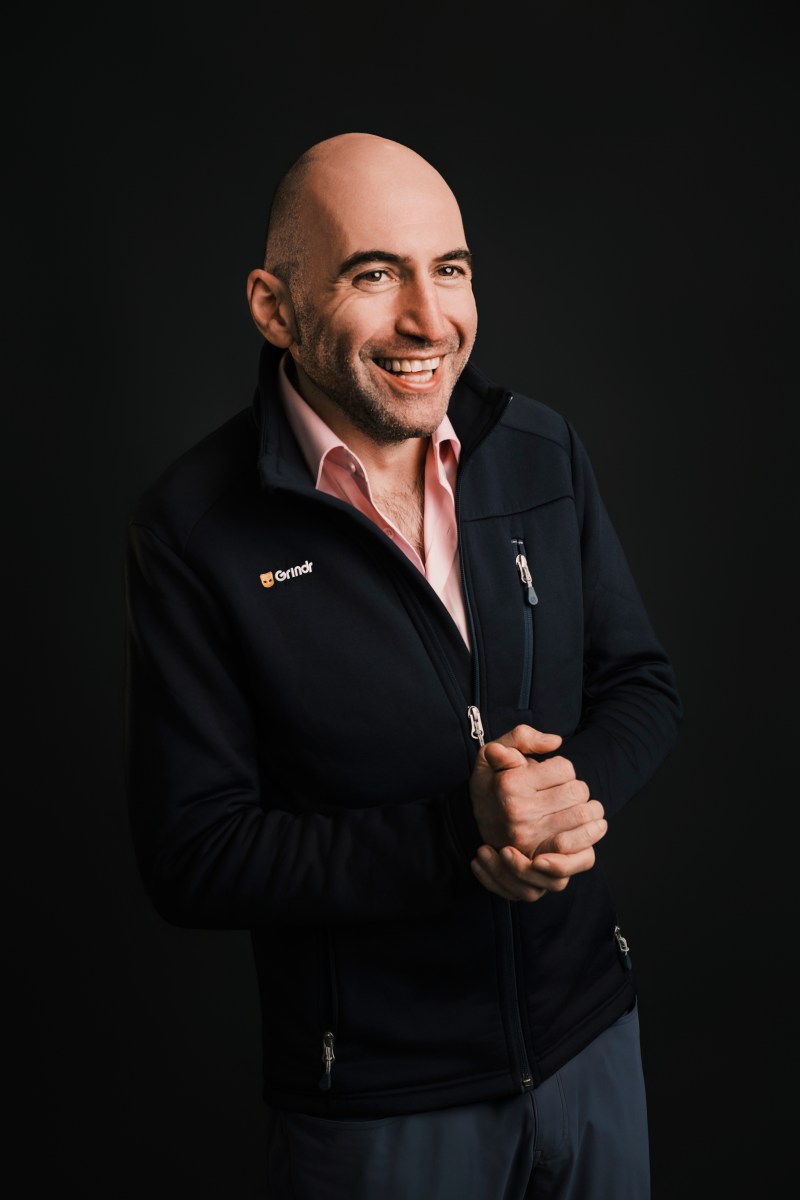
On August 30, 2026, TechCrunch published a wide-ranging Q&A with Grindr CEO George Arison in which he detailed the company's "EDGE" subscription tier, its healthcare ambitions, and his running argument that Wall Street applies a "Grindr discount" to the stock because of what the app is. The interview is the clearest public accounting yet of a strategy that turns a hookup app into what Arison calls a "gayborhood in your pocket."
Why It Matters
Grindr is running the clearest live experiment in whether sexual-adjacent platforms can escape their category ceiling by becoming health companies. Woodwork already sells ED medication in-app — that is a sexual health telehealth business operating inside a dating app, with a distribution advantage that Hims and Ro would pay enormous sums to replicate. If the in-app AI transaction bot converts at anything like normal telehealth rates, Grindr becomes a meaningful competitor in men's sexual health without ever having built a patient-acquisition funnel. The EDGE pricing is worth watching as an industry signal rather than a product. If a $350/month tier finds any real subscriber base, it establishes that intimacy-adjacent AI features command luxury-goods pricing — a data point every AI companion company will cite in its next fundraise. If it flops, it becomes the cautionary example for the same cohort. The "Grindr discount" also deserves to be taken seriously as a structural finding, not a founder's grievance. A profitable, 25%-plus-growth-for-16-quarters company trading at a 35% discount to peers, with documented instances of banking and consulting refusal, is the public-markets version of the same debanking and reputational-risk problem that constrains every sex tech company. The difference is that Grindr is large enough and listed enough to make the discount measurable.The numbers first. Grindr's revenue is on pace to roughly triple from $195 million in 2022 to a guided $540 million-plus this year, with adjusted EBITDA margins above 40%. That growth came almost entirely from monetizing existing users rather than adding new ones: in Q2 2026 the company had 1.4 million paying users, or 9% of its base, up from under 6% conversion when Arison arrived, with ARPU nearly doubling. Headcount is 175 U.S. employees plus a Colombia team, with roughly 94–95 people across all technical roles. Arison says about 80% of Grindr's code is now AI-written and engineering productivity is up 2.5x year over year.
EDGE is the controversial part. The AI-powered tier sits above the existing XTRA ($23.99) and Unlimited ($44.99) subscriptions, and test pricing in Canada worked out to roughly $350–375 a month in U.S. dollars — a figure that drew predictable mockery online ("literally who's paying for this"). Arison's clarification is that EDGE has not launched; the pricing quoted was one point in a range run to understand elasticity, not a final price. "We're not selling AI itself; we're selling features derived from it," he said, describing the use of behavioral and intent data, with consent, to produce better matches than a sparse profile allows. Retention on those features is, per Arison, higher than anything Grindr has shipped before. He compares the tier to a Tesla Model X or S — a premium flagship whose capabilities eventually trickle down. EDGE goes live toward the end of this year or early next.
The underlying product thesis is about pool size. Even in San Francisco, Arison notes, the total gay population is maybe 50,000–60,000 people — not a large dating pool. EDGE's AI matching is designed to break the geographic constraint and surface compatible people in other cities. He's candid about the limits of the evidence: "We don't track people's relationships after the fact — that's going too far."
Healthcare is the second expansion vector, and it's the one that puts Grindr squarely in the sexual health business. The company started with cash-pay products under a line called Woodwork — ED medications, GLP-1s, peptides — and recently launched an AI bot that handles the full transaction inside the app rather than routing users to Woodwork.com. The second bucket is HIV prevention: Grindr has committed to giving 10 million people direct access to information on where to get PrEP, domestically through its in-app health center and internationally. Actual clinical care — connecting users to a gay doctor via telehealth — is explicitly long-term. Subscriptions remain about 83% of revenue, down from ~86% in 2022.
On the stigma question, Arison cites an investor who showed him a financial model with a literal "Grindr discount" line item knocking 25% off fair value, a consulting firm that declined to work with the company over reputational concerns, and a bank that refused its deposits during the Silicon Valley Bank crisis. The stock trades at roughly 11x 2027 EBITDA, about a 35% discount to peers — though Morgan Stanley upgraded it to overweight in July citing EDGE and the telehealth push, and Goldman Sachs and Raymond James have raised price targets. The stock is up roughly a third over six months.
Sources
- Grindr wants to be the everything app for gay men; investors are still deciding whether it can pull it off — TechCrunch
- Grindr is about to get even more expensive & here's why — Queerty
- Grindr Targets Wealthy Users With $350 Monthly Subscription — Online Personals Watch
Update — 2026-09-02
Initial entry — story first created.
Update — 2026-10-17
Ronan Farrow looks at the data behind gAI. On October 13, 2026, investigative journalist Ronan Farrow began a video series on how companies collect data to train AI. His first subject was Grindr's gAI, the AI layer that powers the EDGE premium tier covered in this story. The finding is in Grindr's own privacy guidance, and nobody disputes it. What Grindr calls "limited data" (profile photos, age, display name and taps) may be used to train its AI by default unless users opt out, under Privacy Settings → AI Technology Controls. More sensitive data, including chat content, sexual preferences and precise location, needs separate, explicit consent. Instinct reports that Grindr says it does not use HIV status or testing-reminder data for AI training. Farrow pointed to research showing most people never change default settings.
A Grindr spokesperson told Queerty: "Privacy and discretion are fundamental to Grindr, and we provide our users meaningful control over how their data is used... they can opt-out at any time of having their information used for AI-powered features and AI training." Coverage connected the default to Grindr's record. Norway's 2021 NOK 65M fine was upheld on appeal in 2025 (GCN). On October 12, regulators fined Microsoft's Xandr NOK 92M for relaying Grindr users' data. In September, Grindr agreed to a £26M UK settlement over shared HIV-status data.
There was a second problem for Grindr's image. On October 15, Queerty reported that critic Nick Wolny had resurfaced a podcast interview in which CEO George Arison said he avoids Anthropic's Claude because the company refused Pentagon requests related to mass surveillance and autonomous weapons ("I was outrageously taken back by the choices they made about working with the DoD"). For an app whose users have historically had good reason to fear state surveillance, the comment drew criticism.
What changed: EDGE is priced at around $350 a month on the promise that gAI understands users better than the free app does. Opt-out-by-default training on photos and behaviour is how that understanding gets built, and it's now being explained to a mainstream audience by one of the best-known investigative reporters in the US. The regulatory risk is real. Under GDPR, sexual-orientation data is special-category data, and a dating app built for gay men has trouble arguing that its users' photos and taps reveal nothing about orientation. Expect European DPAs to ask that question, and expect the opt-out rate to become a metric investors watch.
New Sources
- Ronan Farrow's latest investigation is "for the gays" & targets Grindr's controversial "gAI" feature — Queerty (Oct 13, 2026)
- Grindr Is Using AI, But What Does That Mean for Your Private Chats? — Instinct Magazine (Oct 14, 2026)
- Investigative journalist Ronan Farrow explains how Grindr uses personal data to train AI — GCN (Oct 14, 2026)
- After Grindr gets busted for sharing user data, its CEO comes out in favor of state surveillance — Queerty (Oct 15, 2026)