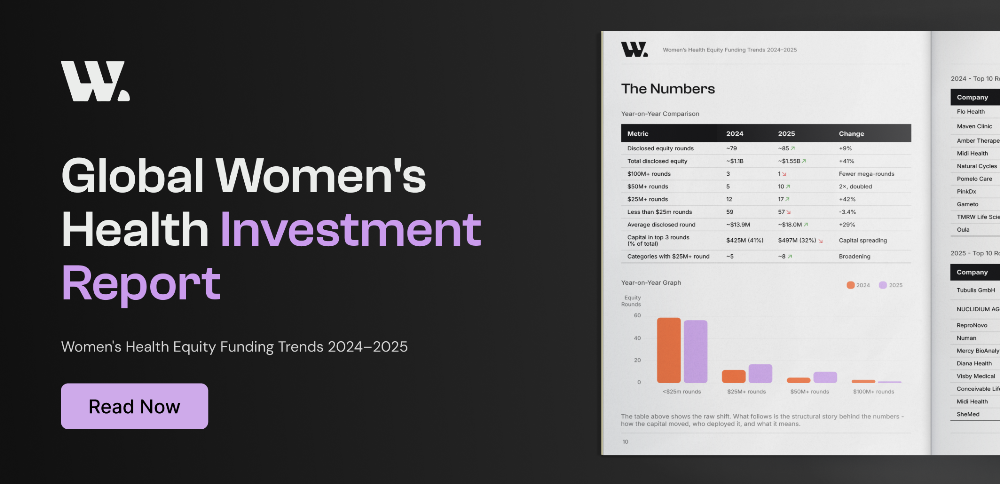
On July 15, 2026, FemTech World reported findings from W Group's first Global Women's Health Investment Report, "The Road to the Era of Scale," which found that women's health companies raised a record $1.55 billion in disclosed equity in 2025 — up 41 percent year on year. The report tracks more than 500 funding stories and 164 equity rounds across 15 categories and 30-plus countries, and notes that 85 companies raised equity in 2025, the highest single-year company count on record.
Why It Matters
Femtech and women's health have historically been chronically underfunded relative to market size, and the sector has spent years fighting the perception that it's a niche. A record $1.55B — with breadth across categories and geographies rather than one or two headline deals — is exactly the kind of data point that reframes women's health as a durable asset class rather than a thematic fad. For the sexual-wellness-adjacent portion of the market (menopause, perimenopause, pelvic health, sexual function, contraception), broadening capital is what funds the next generation of hormone wearables, diagnostics, and care-coordination platforms Afterglow has been tracking all year. The Series A "valley of death" is the report's most actionable warning. A healthy seed pipeline that can't graduate to growth capital produces exactly the pattern the sector has seen before — promising companies stalling or getting acqui-hired below potential (Elvie's 2025 administration being the cautionary tale). The emergence of a women-specific GLP-1/metabolic category is also a signal worth watching: it drags the biggest consumer-health story of the decade (GLP-1 drugs) directly into women's health, and it's the kind of category expansion that pulls generalist investors into a space they previously ignored.According to the report, the headline dollar figure is not the most important finding. The bigger structural shift is in the distribution of capital: money that in prior years concentrated in a handful of mega-rounds is now spreading across more companies, more sub-categories, and more countries. W Group frames this as the sector maturing from a few marquee bets into a broader "Era of Scale." The report also flags an entirely new investment category that didn't exist twelve months earlier — women-specific GLP-1 and metabolic health — pointing to UK startup SheMed's $50 million Series A as the first dedicated raise of its kind.
The report identifies one structural risk that could determine whether 2025's momentum holds: a bottleneck at Series A that is leaving a number of promising seed-stage companies stranded. Molly Taylor, head of content at W Group, said 2025 was "the biggest year women's health has ever had," but argued the most important finding "isn't the headline number — it's that the money has stopped pooling at the top." She added that "the Era of Scale is real. It's just not finished, and the Series A gap is where it could stall. Closing that gap is the highest-leverage move this ecosystem can make in 2026."
Sources
- Women's health draws record $1.55bn in equity as capital spreads beyond the mega-rounds — FemTech World
- Women's health draws record in equity — Med-Tech Insights
Update — 2026-07-17
Initial entry — story first created.